





A Gateway in the Clouds
The airport mentioned in the headline is officially known as Kushok Bakula Rimpochee Airport (IATA code: IXL). Located in Leh, the capital of Ladakh, it holds the title of India's highest commercial airport, sitting at a staggering altitude of 3,256 metres,
or 10,682 feet, above sea level. Named after the revered spiritual leader and statesman, the 19th Kushok Bakula Rinpoche, the airport is more than just a transit hub; it's the primary gateway connecting the remote, high-altitude desert region to the rest of the world. For several months a year, when heavy snowfall renders the mountainous roads impassable, this airport becomes the sole lifeline for residents, the military, and the steady stream of tourists drawn to Ladakh’s otherworldly beauty.
An Engineering and Piloting Marvel
Operating an airport at such an altitude is an immense technical challenge. The air is significantly less dense than at sea level, which has a dual effect on aircraft: it reduces engine thrust and diminishes the lift generated by the wings. To compensate, planes need to achieve higher speeds for both takeoff and landing, necessitating a long runway. The challenges don't end there. Due to powerful mountain winds that develop in the afternoon, all commercial flights are restricted to a narrow operational window in the morning. The airport is nestled in a valley, surrounded by towering peaks. This topography dictates a one-way approach for pilots, who must land from one direction and take off from the other, with no room for error. Pilots flying into Leh require special training to navigate the visual approach, as the complex terrain makes standard instrument landings impossible.
The Passenger's Point of View
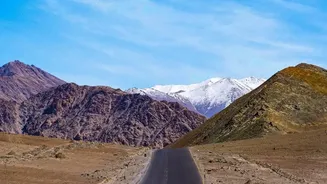
For travellers, the flight into Leh is one of the most scenic and dramatic in the world. The descent offers breathtaking views of the sprawling Himalayan and Karakoram ranges, with barren, snow-dusted peaks stretching as far as the eye can see. Landing feels like descending into a massive natural bowl. Upon arrival, passengers are immediately greeted by the crisp, thin air and advisories to acclimatize. The high altitude means lower oxygen levels, and visitors are strongly encouraged to rest for at least a day to avoid acute mountain sickness. The airport itself, while undergoing significant expansion to accommodate growing traffic, operates with a unique rhythm dictated by its environment and its dual-purpose role.
A Vital Strategic Asset
Beyond its civilian function, Kushok Bakula Rimpochee Airport is a premier and strategic airfield for the Indian Air Force (IAF). Its proximity to the Line of Actual Control (LAC) makes it indispensable for national security, enabling the rapid movement of troops and supplies to forward areas. The airport is a critical air bridge, especially during the harsh winters when it's the only way to sustain military outposts. This dual civil-military role means security is paramount, with a heavy presence of army and police personnel. Photography and videography of military assets and operational areas are strictly prohibited to protect sensitive information.
Reaching Even Higher
While Leh holds the crown for the highest commercial airport, India's high-altitude aviation capabilities are pushing even further. Recently, India has fully operationalised the Nyoma Advanced Landing Ground, also in eastern Ladakh. Situated at a breathtaking altitude of around 13,700 feet, Nyoma is now one of the world's highest operational airbases, capable of handling fighter jets like the Rafale and Su-30MKI as well as heavy transport aircraft. Its development marks a significant enhancement of India's strategic posture in the region. So, while you'll still fly into Leh for your tourist visit, the nearby Nyoma airfield represents the next chapter in India’s mastery of high-altitude infrastructure.