








A Discovery from the Archives
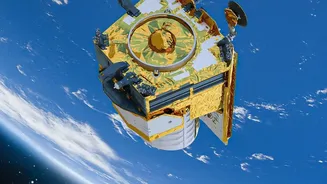
Chandrayaan-1, launched by ISRO in 2008, fundamentally changed our understanding of the Moon, most famously by confirming the presence of water molecules. Though its operational life was brief, the data it collected is a gift that keeps on giving. Recently,
scientists from the Physical Research Laboratory (PRL) in Ahmedabad revisited this archival data, applying new analytical techniques to explore one of the Moon's most intriguing regions: the South Pole. What they found was not discovered through new images, but by painstakingly decoding the chemical information hidden within years-old observations, leading to a groundbreaking discovery published in The Planetary Science Journal.
The Ghost in the Machine
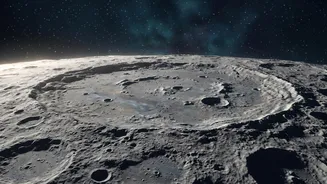
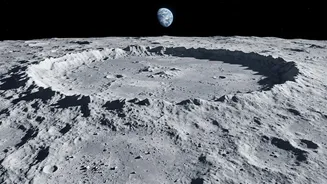
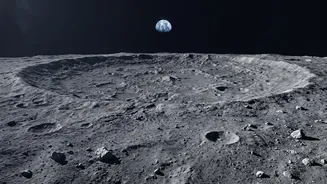
The team confirmed the existence of a massive, ancient impact structure named the Australe Basin, located in the Moon's southeastern hemisphere. This is no ordinary crater. It’s a geological ghost—a basin so ancient that billions of years of subsequent volcanic activity and smaller impacts have almost completely erased its physical shape. Its rim is no longer visible to standard imaging techniques that look for topographic features like the edge of a crater. Instead of seeing a basin, the scientists found its mineralogical fingerprint. When a massive asteroid or comet struck the Moon billions of years ago, the impact was so powerful that it dredged up materials from deep within the lunar crust and mantle, flinging them outwards in a massive ring.
Reading the Mineral Clues
Using data from the Moon Mineralogy Mapper (M³) , a NASA instrument aboard Chandrayaan-1, the PRL scientists detected a distinct, circular pattern of a mineral called orthopyroxene. This mineral is associated with deep crustal material, and its ring-like distribution delineates the boundary of the long-vanished Australe Basin. It was like finding the chalk outline of a structure that has long since disappeared. Furthermore, the volcanic basalts within this region are unusual; they are low in calcium and rich in magnesium, a composition different from most other volcanic plains on the Moon. This unique chemical signature helped confirm that this area has a distinct and violent history.
Rewriting Lunar History
This discovery is significant for several reasons. For one, it provides a new method for finding the Moon’s oldest and most eroded impact basins, of which hundreds are thought to exist but only a fraction have been found. More excitingly, the Australe Basin could potentially be older than the South Pole-Aitken (SPA) Basin, which is currently considered the largest and oldest confirmed impact structure on the Moon. The absence of certain minerals expected from a more mature lunar crust suggests the Australe impact may have occurred over four billion years ago, while the Moon’s magma ocean was still solidifying. If confirmed, this would make it a relic from the solar system's earliest, most chaotic era.
The Legacy of Chandrayaan
The revelation of the Australe Basin is a powerful testament to the enduring value of India's first lunar mission. It underscores that the real legacy of a space mission isn't just in its active operational phase but in the decades of scientific inquiry its data can fuel. This finding not only helps scientists piece together the Moon’s violent past but also provides crucial context for future exploration. As India plans for ambitious future missions, including sample return, understanding the deep history and composition of regions like the Australe Basin will be critical in choosing where to land and what secrets to unlock next.