


A Historic First
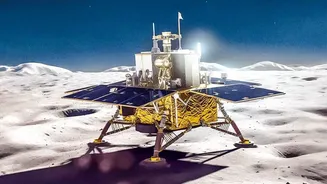
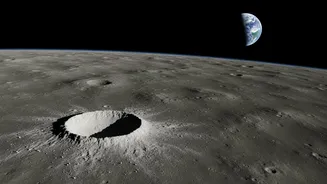
In a landmark achievement for space exploration, China's Chang'e-6 probe successfully returned to Earth in June 2024 with nearly two kilograms of precious cargo. For the first time, scientists have physical material from the Moon's far side, the hemisphere
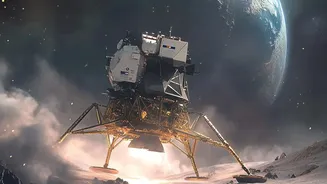
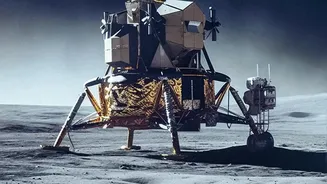
that perpetually faces away from Earth. The lander touched down in the Apollo Basin, a crater situated within the colossal South Pole-Aitken (SPA) Basin—the largest and oldest known impact crater in the entire Solar System. This ancient region, formed some 4.2 billion years ago, is a fundamentally different and less-explored territory than the near side visited by the Apollo and previous lunar missions. Getting there was a feat in itself, requiring a dedicated relay satellite, Queqiao-2, to bridge communications between the lander and ground control on Earth. The mission's success marks a pivotal moment, opening a new chapter in lunar science by providing ground truth to a place previously studied only from orbit.
The 28 Fragments of History
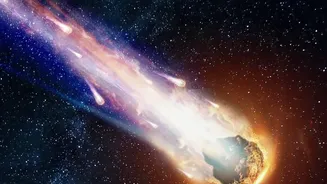
Among the returned soil and rock, scientists have focused intensely on specific pieces of evidence that act as time capsules. One groundbreaking study identified 28 distinct rock fragments, or clasts, bearing the tell-tale textures of being melted by intense heat and pressure. These are the direct remnants of ancient asteroid impacts. Using sophisticated argon-argon dating techniques, which measure the decay of isotopes to determine when a rock's geologic clock was reset by an impact, researchers pieced together a stunning timeline of bombardment. The ages of these 28 fragments span an incredible three billion years of lunar history, from 4.33 billion to 1.13 billion years ago. This evidence suggests that the violent asteroid barrage in the early Solar System was not a sudden spike, as some theories like the 'Late Heavy Bombardment' proposed, but a long, gradual decline in intensity. The far side's surface, having avoided some of the massive lava flows that resurfaced the near side, has preserved this cleaner, more detailed record of cosmic violence.
Rewriting Solar System Origins
The secrets held within these fragments extend far beyond the Moon. By analysing tiny metal particles embedded in the impact clasts, scientists discovered a dramatic shift in the type of asteroids hitting the Moon over time. The analysis revealed that ancient impacts, before about 2.8 billion years ago, were primarily from non-carbonaceous asteroids originating from the inner solar system. However, in younger samples, the proportion of fragments from carbonaceous asteroids—which are rich in water and organic matter—rose significantly. This finding has profound implications, suggesting that the delivery of water to the Earth-Moon system by these types of asteroids may have ramped up later than previously thought. Furthermore, the samples are helping to confirm a long-held theory that the very early Moon was covered in a global 'magma ocean'. The composition of basalt found in the samples supports this model of a molten, primordial body that slowly cooled and crystallised to form the crust and mantle we see today.
A Tale of Two Moons
The Chang'e-6 samples confirm what remote sensing has long suggested: the Moon’s two sides are strikingly different. The far-side soil is looser, more porous, and less dense than samples returned from the near side. The mineral makeup is also distinct, with a higher content of plagioclase and less olivine, indicating a different geological evolution. Scientists also discovered that the far side's mantle source appears to have significantly less water than the near side's, pointing to a lopsided distribution of volatiles across the Moon. Perhaps most intriguingly, the discovery of KREEP—a type of rock rich in potassium (K), rare-earth elements (REE), and phosphorus (P)—on the far side challenges theories that this radioactive material was blasted almost exclusively to the near side by a cataclysmic impact. These differences are crucial clues to solving the enduring mystery of why the two lunar hemispheres are so asymmetrical.
The Wider Context and Future Ambitions
Chang'e-6 is a cornerstone of China's ambitious, methodical lunar exploration program, which has progressed from orbiters to landers, rovers, and now two successful sample-return missions. This success not only showcases technological prowess but also paves the way for the next phase of exploration. The program's plans include Chang'e-7 in 2026, which will explore the lunar south pole for resources, and Chang'e-8 in 2028, aimed at testing technologies for in-situ resource utilisation. These missions are building blocks for a far grander vision: a crewed Chinese lunar landing by 2030 and the eventual construction of an International Lunar Research Station near the Moon's south pole. The data from Chang'e-6 is therefore not just academic; it is vital reconnaissance for humanity's sustained return to the Moon.