





What are Talking Cars?
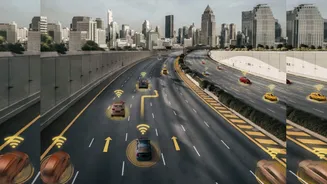
Imagine your car getting a heads-up that a truck three vehicles ahead just slammed on its brakes, even when it’s completely blocked from your view. That’s the core idea behind Vehicle-to-Vehicle (V2V) communication. It’s not about cars having conversations;
it’s about them creating a local, wireless safety network. Each equipped vehicle continuously broadcasts tiny packets of information: its speed, direction, position, and braking status. Other vehicles nearby receive these messages in milliseconds, creating a real-time map of the immediate traffic environment. This allows a car’s onboard system to warn the driver—or even assist with braking—about a hazard long before a human or a camera could possibly see it. The Indian government is now taking concrete steps to make this technology a standard feature on our roads.
The Government's Roadmap for V2V
The Ministry of Road Transport and Highways (MoRTH) has released a draft notification proposing a significant leap in automotive safety. The plan is to make V2V communication systems mandatory for all newly manufactured vehicles from October 1, 2028. This ambitious mandate covers not just cars, but a wide array of vehicles under categories L (two- and three-wheelers), M (passenger vehicles, including buses), and N (goods vehicles like trucks). To ensure a smooth transition, the government has proposed a phased rollout. From October 1, 2027, any vehicle voluntarily fitted with a V2V system must comply with the new Automotive Industry Standard (AIS-230). A crucial preparatory step was taken in June 2026, when the Department of Telecommunications delicensed the 5.9 GHz frequency band required for these systems to operate, removing a major regulatory hurdle.
How Sudden-Braking Alerts Work
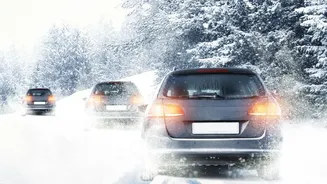
The sudden-braking alert is one of the most vital applications of V2V technology for India. When a V2V-equipped car brakes hard, it instantly broadcasts an 'emergency brake alert' message. Every other equipped vehicle in the vicinity receives this alert. If your car is behind the braking vehicle, its system analyzes the data. It knows the location of the braking event, its own speed, and the distance between the two vehicles. Even if there are several non-V2V cars or a large truck blocking your view, the radio signal gets through. Your dashboard might flash a visual warning, sound an audible alarm, or send a vibration through the steering wheel, giving you crucial extra seconds to react and prevent a potential pile-up. This moves vehicle safety from a reactive system (airbags) to a proactive, networked one.
Why This Matters for Indian Roads
V2V technology is more than a luxury feature; it's a potential lifesaver tailored for the unique challenges of Indian roads. Our traffic is a complex mix of cars, bikes, auto-rickshaws, trucks, and sometimes even animals, often with unpredictable lane discipline. Standard sensor-based systems like cameras and radar, while useful, have limitations. They can't see around corners or through other vehicles. V2V communication overcomes this 'line-of-sight' problem. It can provide alerts for forward collisions, unsafe lane changes, and even wrong-way drivers—scenarios all too common in India. By complementing existing Advanced Driver Assistance Systems (ADAS), V2V adds a layer of collective awareness that could significantly reduce the high number of road accidents.
Hurdles on the Road Ahead
While the promise is enormous, the path to fully realizing V2V’s benefits has its challenges. The biggest is the 'critical mass' problem. The technology's effectiveness grows exponentially as more cars on the road are equipped with it. During the initial years, new V2V cars will share the road with millions of older, non-connected vehicles, limiting the system's overall impact. The cost of the onboard units and the potential need for infrastructure upgrades (for the broader Vehicle-to-Everything, or V2X, ecosystem) are also significant considerations. Finally, ensuring the security of this communication network to prevent hacking or false alerts, and protecting user privacy, will be paramount for building public trust.