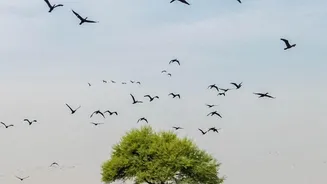








Invisible Highways in the Sky
Migratory birds don't travel randomly; they follow ancestral routes known as flyways. These are like invisible highways in the sky, connecting breeding grounds in the cold north with wintering areas in the warmer south. India is a crucial destination
on the Central Asian Flyway (CAF), a vast corridor spanning 30 countries from Siberia to South Asia. For hundreds of species, including the iconic Bar-headed Goose and the Amur Falcon, India’s wetlands, grasslands, and forests are essential for survival. These flyways are not just routes but a series of vital stopover sites—lakes, marshes, and coastal mudflats—where birds must rest and refuel for the next leg of their marathon flight.
A Patchwork of Protection
The core of the problem is that our conservation efforts are fragmented. A bird might be safe in a national park in one country but face grave dangers just a few hundred kilometres away in another. A landmark study published in the journal Science revealed that a staggering 91% of migratory bird species lack adequate protection for at least one part of their annual cycle. While a country might meet its own conservation targets, its efforts can be undermined if the birds it protects are not safe elsewhere along their route. This creates a perilous patchwork where safe zones are islands in a sea of threats. Even within a single country, development and agriculture often create hostile landscapes between designated sanctuaries.
Peril on the Wing
These conservation gaps are not empty spaces; they are filled with dangers. The most significant threat is habitat loss and degradation. Wetlands across South Asia are being drained for agriculture and urban expansion, stripping birds of essential refuelling stations. Pollution from pesticides and industrial waste contaminates their food and water sources. Linear infrastructure, such as power lines and wind turbines, poses a lethal collision risk. In some regions, illegal hunting still takes a heavy toll. For species that rely on a few specific stopover sites, like many shorebirds, the loss of even one critical wetland can have a devastating impact on the entire population.
A Chain as Weak as its Links
The consequences of these gaps are stark. More than half of all migratory bird species are experiencing population declines. In India, studies show long-distance migrants are declining faster than resident birds. The Siberian Crane, which once wintered in Bharatpur, has not been reliably seen in India for years, a tragic symbol of what is at stake. The decline of these birds is not just an ecological loss; it signals a failing in our environment. Migratory birds are crucial indicators of ecosystem health. Their disappearance disrupts natural processes like pest control and seed dispersal, which have wider implications for environmental stability and human well-being.
Bridging the Divide
Addressing this challenge requires a perspective as borderless as the birds themselves. Protecting a species in its breeding grounds is not enough if its wintering habitat is destroyed, or its migratory pitstops disappear. International agreements like the Convention on Migratory Species (CMS) provide a framework for countries to work together, but progress can be slow and fragmented. Effective conservation requires coordinated action across entire flyways—sharing data, aligning policies, and protecting a network of connected habitats. This means looking beyond just national parks and creating bird-friendly landscapes where agriculture, infrastructure, and nature can coexist. The journey of a single bird connects continents, and its protection is a shared responsibility.