






From your local chai-wallah to airport boarding passes, QR codes are everywhere. These pixelated squares have quietly become part of daily life, but what makes them so much more powerful than the familiar striped barcodes they've all but replaced?
The Old World: One-Dimensional Barcodes
For
decades, the standard for automated data was the one-dimensional (1D) barcode—the series of vertical black lines you see on everything from grocery items to library books. These codes work by encoding information horizontally. A laser scanner reads across the pattern of varying line widths and spaces, translating it into a short string of characters, typically a product identification number up to about 25 characters long. The barcode itself doesn't contain the product's name or price; it holds a reference number that a system then looks up in a database to find the relevant information. Think of it as a license plate for a product, not the full registration document.
Entering the Second Dimension
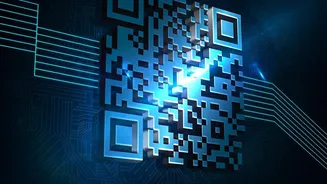
A QR code, which stands for 'Quick Response' code, is a two-dimensional (2D) or matrix barcode. Instead of just storing information in a single horizontal line, it uses a grid of black and white squares to encode data both horizontally and vertically. This simple but brilliant shift allows a QR code to store vastly more information in a much smaller physical space. Those three large squares you see in the corners are called position detection patterns. They help a scanner—like your smartphone camera—instantly know the code's orientation, allowing it to be read from any angle. This makes scanning incredibly fast and efficient, living up to the 'Quick Response' name.
A Leap in Data Capacity
The primary advantage of using two dimensions is a massive increase in data storage. While a standard barcode might hold around 20-25 characters, a single QR code can store thousands. The maximum capacity for a standard QR code is 7,089 numeric characters or 4,296 alphanumeric characters (letters and numbers). This means a QR code doesn't just have to be a simple product ID. It can hold a full website URL, a vCard with contact details, Wi-Fi login credentials, a text message, or payment information directly within the code itself, no database lookup required.
Designed to Withstand Damage
Another ingenious feature of QR codes is their built-in error correction. Thanks to something called the Reed-Solomon algorithm, a QR code can often be scanned successfully even if it's dirty, scratched, or partially covered. When a QR code is created, you can choose from four levels of error correction: L (Low), M (Medium), Q (Quartile), and H (High). These levels allow for the recovery of approximately 7%, 15%, 25%, and 30% of the data, respectively. This redundancy is what allows a logo to be placed in the middle of some QR codes or lets a worn-out sticker on a payment counter continue to work reliably.
From Car Parts to Contactless Payments
The QR code was invented in 1994 by a Japanese company, Denso Wave, to track parts in the automotive manufacturing process. The creator, Masahiro Hara, was inspired by the grid of a Go board. Denso Wave made the technology an open standard, meaning anyone could use it without paying licensing fees, which was crucial for its global adoption. In India, the QR code's moment arrived with the Unified Payments Interface (UPI) revolution. Its low cost—just a simple printout compared to an expensive point-of-sale machine—made it the perfect tool for bringing millions of small merchants into the digital economy. Today, India is one of the world's largest markets for QR code usage, a testament to the power of this two-dimensional wonder.