




Reading a Galaxy's Fossil Record
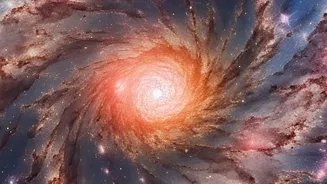
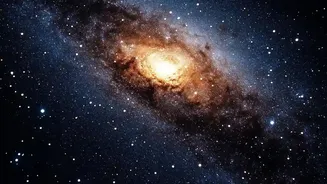
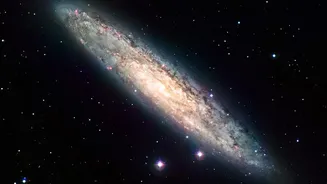
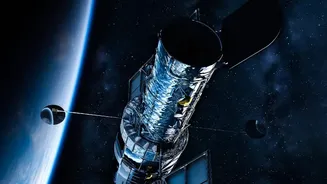
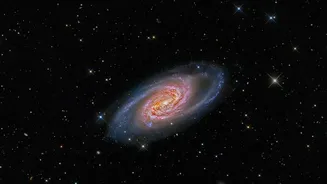
At 2.5 million light-years away, the Andromeda galaxy is a near-perfect laboratory for studying galactic evolution. It is close enough for the Hubble Space Telescope to resolve hundreds of millions of individual stars, yet far enough that we can see its
entire structure. A team of astronomers did just that, using data from two extensive Hubble surveys to create a detailed map of the galaxy's history. They treat the stars as a cosmic fossil record: massive, bright blue stars are young and short-lived, while smaller, redder stars are much older. By analyzing the distribution of these stars, researchers can rewind the clock and reconstruct how, where, and when Andromeda has been building itself over the ages.
The Great Star-Making Slowdown
The study revealed a clear and steady decline in star formation over the past 500 million years. During that earlier period, Andromeda was creating stars at a rate of about one solar mass per year, a pace comparable to our own Milky Way. However, the study shows that this rate has been consistently dropping. By about 40 million years ago, star production had already fallen by half. The decline became even more dramatic in the most recent cosmic past, with today's rate plummeting to just one-fifth of a solar mass per year, suggesting our neighbour is entering a much quieter phase of its life.
A Tale of Two Galaxies
This finding puts the life story of Andromeda into sharp contrast with our own galaxy. While Andromeda is slowing down, the Milky Way continues to form stars at a relatively steady and more vigorous rate of one to two solar masses per year. This suggests that despite being two large spiral galaxies in the same cosmic neighbourhood, their evolutionary paths have been quite different. Andromeda appears to be a galaxy that had a more tumultuous youth, including a massive burst of star formation about two billion years ago, and is now settling into a quiescent middle age. Researchers have described the current phase as a galaxy taking a “breather” after a period of high activity.
The Prime Suspect: A Galactic Collision
So what caused the recent, sharp drop-off? Astronomers have a prime suspect: M32, a small satellite galaxy orbiting Andromeda. The new data shows that the slowdown in star formation is particularly pronounced on the side of Andromeda's disk closest to M32, with the decline starting around 60 million years ago. The leading theory is that M32 may have plunged through Andromeda’s disk, and its gravity disrupted the vast clouds of gas and dust, scattering the raw materials needed to form new stars. While scientists are careful to state that they cannot yet definitively blame M32, they note that the dwarf galaxy is “the most likely suspect.”
Cosmic Forensics and Our Future
Understanding Andromeda's past is more than just an academic exercise; it provides crucial context for our own galaxy and the future of our local corner of the universe. Studying Andromeda gives us an external viewpoint on how a large spiral galaxy ages, something we can't get from our position inside the Milky Way. These findings also add a new layer to our understanding of the eventual collision between the Milky Way and Andromeda, predicted to occur in about 4.5 billion years. Knowing the current state and energy of Andromeda helps refine models of that future galactic merger. This detailed work is a stepping stone for future observatories like the Nancy Grace Roman Space Telescope, which will be able to map Andromeda's entire disk and provide even more clues to its hidden history.