





An Eclipse for Other Skies
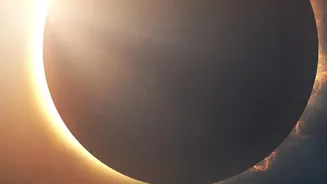
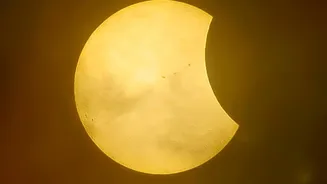
The total solar eclipse of August 12, 2026, was a major astronomical event, creating a path of totality over parts of Europe, including Spain and Iceland. However, in India, the spectacle occurred late at night, long after the sun had set, making it impossible
to witness directly. Yet, the date was marked on many calendars not for sky-gazing, but for the discussions and traditional precautions it invariably triggers. The very occurrence of a 'grahan' is enough to bring ancient beliefs to the forefront of modern life, even when the event itself is thousands of kilometres away.
The Myths: Swallowed Suns and Harmful Rays
In Hindu mythology, the most popular story attributes eclipses to the demon Rahu, whose disembodied head swallows the sun as an act of eternal vengeance. This narrative forms the foundation for a host of taboos. Foremost among them are warnings for pregnant women to stay indoors, lest the eclipse cause harm to their unborn child. Another widespread belief is that food and water become impure during an eclipse, leading many to fast, discard cooked meals, and prepare fresh food only after the event concludes. Other prohibitions include avoiding sleep and refraining from using sharp objects like knives.
The Science: No Poison, Just Light
Scientific bodies and astronomers consistently debunk these fears. There are no mysterious or harmful rays emitted during an eclipse that can poison food or affect a human body. The belief that food spoils is often linked to a slight drop in temperature, but there is no evidence this causes contamination any more than the darkness of night does. The only genuine danger associated with a solar eclipse is retinal damage from looking directly at the sun without proper protection. During a total eclipse, the brief moment of totality can be viewed with the naked eye, but any partial phase requires certified solar filters. Since this eclipse was not visible in India, even this risk was non-existent for the population.
A Clash of Generations and Beliefs
Despite clear scientific explanations, these taboos persist, often creating a gentle friction within families. While younger, urban generations may dismiss them as superstition, elders often insist on observing the rituals out of deep-seated faith and tradition. For many, it is not a matter of defying science but of honouring cultural practices passed down through ages. Astrologically, eclipses are considered inauspicious events linked to the shadow planets Rahu and Ketu, prompting many to engage in prayers and meditation to ward off negative energy, regardless of the eclipse's visibility.
The Push for a Scientific Temper
For decades, India's scientific community has worked to promote a scientific temper around celestial events. Organizations like the National Council for Science & Technology Communication (NCSTC) and Vigyan Prasar have led concerted efforts to educate the public. They organize mass viewing events with safe solar filters during visible eclipses and run workshops to dispel misinformation. These campaigns have resulted in what some officials call a "sea change" in the mindset of many people, who now come out to witness these phenomena rather than hide from them. Even as this eclipse passed unseen, Indian scientists were actively involved, with researchers from the Raman Research Institute predicting the sun's coronal structure for observers in Europe.