






The Magic of Manufacturing Flexibility
For decades, the traditional assembly line was a symbol of industrial might, but also of rigidity. Each line was custom-built for one specific model. Producing a different vehicle meant a costly and time-consuming re-tooling of the entire factory. A flexible
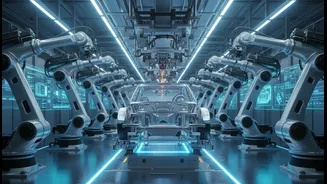
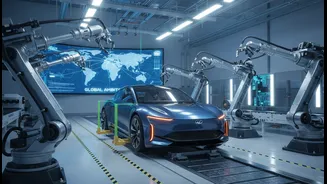
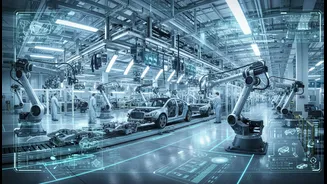
assembly line turns this concept on its head. It is an advanced production system where multiple, distinct vehicle models can be manufactured simultaneously without stopping to reconfigure the machinery. This is made possible through a combination of intelligent robotics, adaptable tooling, and a modular vehicle platform that allows different body styles and specifications to share common engineering anchor points. The goal is to achieve a “zero changeover time,” enabling the factory to respond to market demand in real-time, shifting from producing a sedan to an SUV as seamlessly as a driver changes lanes.
Chakan: The Hub of Innovation
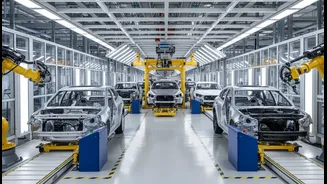
The industrial hub of Chakan, near Pune, is home to the state-of-the-art manufacturing plant of Škoda Auto Volkswagen India Private Limited (SAVWIPL). This facility is the nerve centre of the Volkswagen Group's ambitious INDIA 2.0 project and a prime example of flexible manufacturing in action. Instead of relying on multiple, dedicated production lines for each of its new models, the company invested in a highly flexible main assembly line. This allows it to produce a diverse range of vehicles, including the Škoda Kushaq, Volkswagen Taigun, Škoda Slavia, and Volkswagen Virtus, all under one roof and on the same line. This capability is not just an engineering feat; it's a core strategic decision that makes the Chakan plant one of the most advanced in the country.
The Platform is the Key
The secret sauce behind Chakan's flexibility is the Volkswagen Group's MQB-A0-IN platform. 'MQB' stands for Modular Transverse Matrix, a system that standardizes certain components and dimensions—like the engine position and pedal box—while allowing for variations in wheelbase, track width, and body style. Think of it as a highly sophisticated set of automotive building blocks. By designing all four of its INDIA 2.0 models on this single, adaptable platform, the company ensures that a sedan like the Virtus and an SUV like the Kushaq can move down the same assembly line. The robots and tools are programmed to recognize each model and perform the correct operations, from welding the body panels to fitting the powertrain. This dramatically reduces development costs and production complexity.
A Strategic Edge in a Dynamic Market
This manufacturing agility provides a massive competitive advantage. In a market as dynamic as India, consumer preferences can shift rapidly. If demand for SUVs suddenly surges while sedan sales cool, the Chakan plant can adjust its production mix almost instantly without suffering from idle capacity. This nimbleness reduces financial risk, optimizes inventory, and ensures that dealerships are stocked with the models customers want most. It allows the company to hedge its bets against market uncertainty and operate with greater efficiency. Furthermore, it makes producing niche variants or launching special editions more economically viable, as they can be integrated into the existing production flow with minimal disruption.
Powering the 'Make in India' Dream
The capabilities of the Chakan plant are a powerful endorsement of the 'Make in India' initiative. The facility is not just assembling cars; it is a hub of advanced manufacturing, contributing to a robust local supplier ecosystem and creating highly skilled jobs. The high degree of localization, including for complex components like engines, underscores this commitment. The efficiency and quality achieved through flexible manufacturing have also turned the Chakan plant into a critical export base for the Volkswagen Group. Over 30% of its car production is exported to more than 40 countries, making SAVWIPL one of India's top automobile exporters. This demonstrates that vehicles made in India can meet and exceed the most stringent global standards.