





A New Sentinel in the Solar System
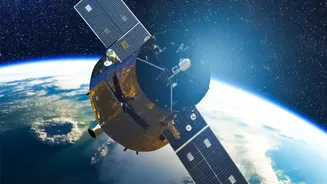
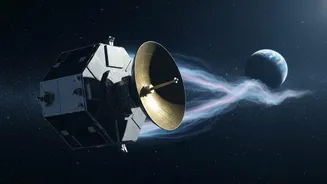
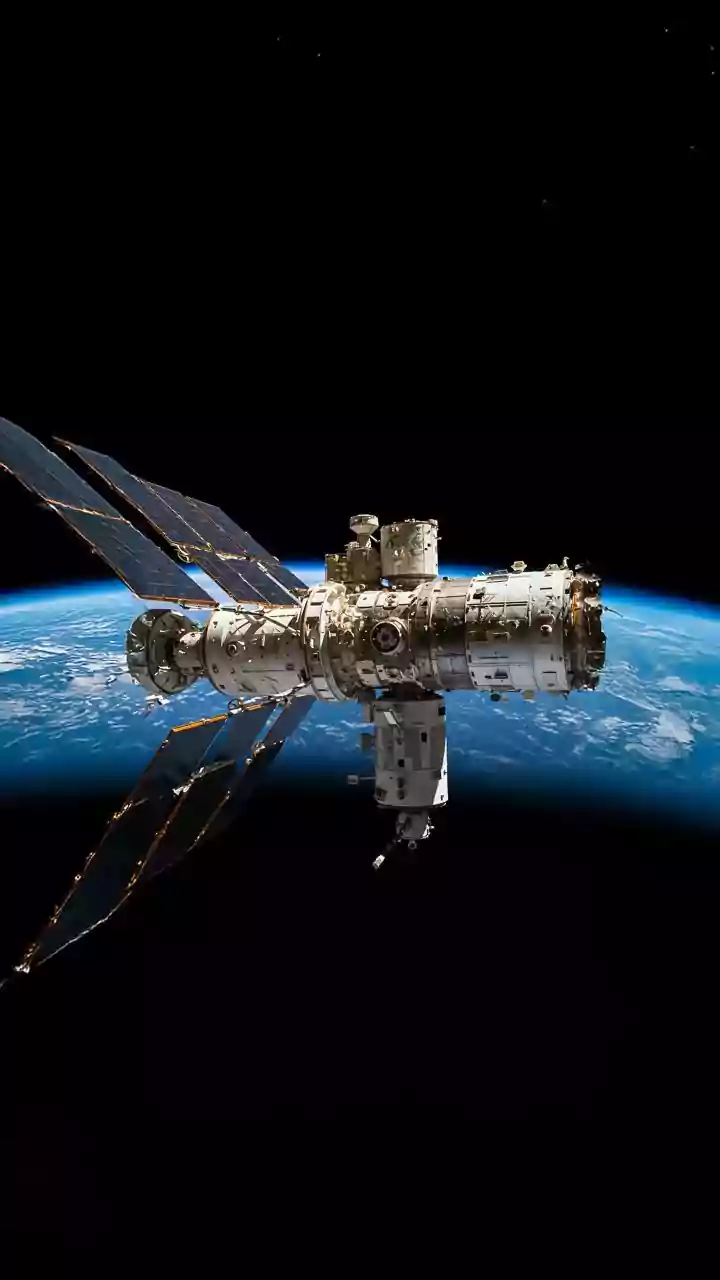
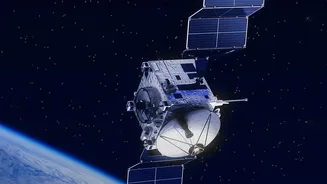
Launched in September 2025, NASA's Interstellar Mapping and Acceleration Probe (IMAP) has a grand, dual-purpose mission. Its primary objective is to act as a celestial cartographer, mapping the boundaries of the heliosphere—the giant magnetic bubble the Sun
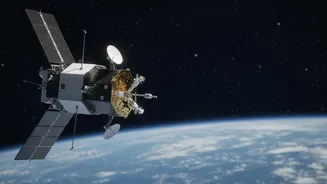
creates around our solar system, which shields us from harsh interstellar radiation. To do this, it collects and analyzes particles that have traveled billions of kilometers from this distant boundary. However, IMAP also has a more immediate and practical role: serving as an advanced sentinel for space weather. Strategically positioned about 1.5 million kilometers from Earth towards the Sun, at a gravitational balance point called Lagrange point 1 (L1), it has an unobstructed view of the Sun's activity. This unique vantage point allows it to sample the solar wind before it reaches our planet.
Decoding the Solar Wind
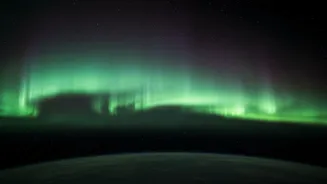
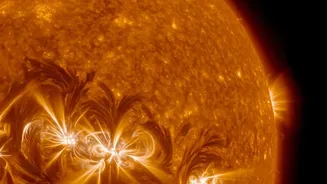
The solar wind is a constant stream of charged particles—mostly protons and electrons—flowing from the Sun's corona at incredible speeds, sometimes exceeding 1.4 million kilometers per hour. While Earth's magnetic field, the magnetosphere, deflects most of this particle onslaught, intense bursts can and do break through. These disturbances, known as geomagnetic storms, are the cause of the beautiful auroras at the poles. But they can also be incredibly destructive, capable of crippling power grids, disrupting telecommunications, degrading GPS signals, and posing a radiation hazard to astronauts and satellites in orbit. Events like Coronal Mass Ejections (CMEs), which are massive explosions of plasma from the Sun, can trigger particularly severe storms. Understanding and predicting the arrival of these solar blasts is therefore critical to protecting our technology-dependent society.
The 'Near-Real-Time' Advantage
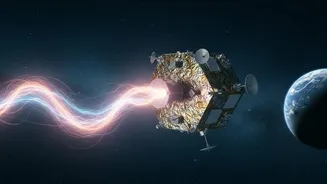
This is where IMAP's breakthrough capability comes into play. The probe is equipped with a suite of ten advanced instruments that measure the characteristics of the solar wind with unprecedented detail. Crucially, a portion of this data is sent back to Earth almost instantly through a system called the IMAP Active Link for Real-Time (I-ALiRT). This system provides a continuous stream of information on solar wind speed, density, temperature, and magnetic field direction. This 'near-real-time' feed is a significant leap forward, offering forecasters a more immediate and richer dataset than previously available. From its L1 position, IMAP's data gives Earth about a 30-minute advance warning of incoming solar wind disturbances, providing valuable time to take protective measures.
Revolutionizing Space Weather Forecasts
The data from I-ALiRT is a game-changer for organizations like the National Oceanic and Atmospheric Administration's (NOAA) Space Weather Prediction Center. Forecasters now have access not only to higher-cadence measurements but also to entirely new data products, such as information on high-energy particles and the composition of the solar wind. This allows for more timely and accurate warnings and alerts. Instead of reacting to a storm as it hits, authorities can proactively issue advisories for satellite operators to put their spacecraft in a safe mode, for power grid managers to brace their systems against electrical surges, and for airlines to reroute flights away from polar regions where radiation exposure could be higher. For human spaceflight, particularly NASA's Artemis missions to the Moon, this early warning system is vital for ensuring astronaut safety.
Securing Our Technological Future
While IMAP's work mapping the far reaches of our solar system is fundamental to science, its role in monitoring space weather has a direct and tangible impact on daily life. Our global economy relies on a fragile web of interconnected technologies, from the satellites that enable global communication and navigation to the power grids that light our cities. A severe geomagnetic storm, like the one that caused a major power failure across parts of Canada in 1989, could cause trillions of dollars in damage today. By providing the data needed to bolster our defenses, IMAP is not just a scientific instrument; it's a critical piece of infrastructure protection. The insights gained from its near-real-time solar wind observations will help engineers design more resilient systems and allow society to better prepare for the inevitable temper tantrums of our star.