




The Ghost Particle and the Ice Cube
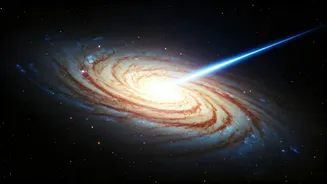
On September 22, 2021, a single, extremely high-energy neutrino slammed into the ice of Antarctica. It was detected by the IceCube Neutrino Observatory, a massive telescope buried deep beneath the South Pole designed for exactly this purpose. Neutrinos
are fundamental particles with almost no mass, and they rarely interact with other matter, which allows them to travel across the cosmos in a straight line, carrying information from their source. This makes them perfect cosmic messengers, but also incredibly difficult to trace. The 2021 detection, named IC 210922A, sent astronomers on a hunt to find what could have possibly created such an energetic particle.
An Unexpected Culprit Emerges
Typically, the prime suspects for producing high-energy neutrinos are supermassive black holes at the centers of active galaxies. However, when researchers pointed their telescopes towards the area of the sky the neutrino came from, they found no evidence of such an object. Instead, they found something else: a galaxy that was faint in visible light but shone brightly at other wavelengths. Heavily obscured by dust, it was nicknamed the "Shadow Blaster." Officially known as JCMT0402−0424, it is a type of galaxy known as a 'dusty starburst galaxy,' located approximately 11 billion light-years away.
A Different Kind of Engine
The Shadow Blaster galaxy is creating stars at a furious rate in an extremely dense and compact core. According to a new study published in the journal Nature Astronomy, it's this intense environment, not a black hole, that's acting as a natural particle accelerator. The theory proposes that the dense, gas-rich core traps high-energy particles, causing them to collide repeatedly and produce neutrinos before they can escape. This discovery was a surprise because it suggests a completely different mechanism for neutrino production than the ones previously identified, which were all linked to the immense gravitational power of black holes.
Solving a Cosmic Accounting Problem
While identifying the source of one neutrino is a major achievement, the implications of the Shadow Blaster are much larger. The astronomers behind the study suggest that this single galaxy is representative of a whole population of similar dusty starburst galaxies that were common during an era known as 'cosmic noon,' when the universe was only a few billion years old. Population models in the study indicate that, as a group, these galaxies could be responsible for up to 20% of the entire diffuse high-energy neutrino background that observatories like IceCube detect. This would help solve a long-standing puzzle of where a significant fraction of these mysterious particles originate.
A Fortunate Cosmic Magnifying Glass
Studying a faint, dusty galaxy 11 billion light-years away is an immense challenge. The team, led by researcher Yuji Urata, had a stroke of luck. The Shadow Blaster happens to be located directly behind another, closer massive galaxy from our perspective. The immense gravity of this foreground galaxy acts as a 'gravitational lens,' bending and magnifying the light from the Shadow Blaster. This natural telescope allowed scientists to see into the distant galaxy's core with a level of detail that would have otherwise been impossible, providing the crucial evidence linking its star-forming activity to the neutrino.