

The Universe's Weighty Problem
For years, astronomers have been baffled by a cosmic timing issue. Observations, particularly from the James Webb Space Telescope (JWST), have confirmed the existence of black holes billions of times more massive than our sun at a time when the universe
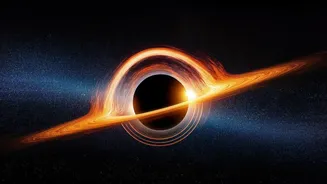
was less than a billion years old. This is a huge problem for traditional theories. Standard models suggest black holes grow by accreting, or pulling in, surrounding gas and dust, or by merging with other black holes. However, there's a physical limit to how fast they can feed, known as the Eddington limit, which is dictated by the outward push of the radiation they emit. Based on these models, there simply wasn't enough time since the Big Bang for them to get so big, so fast.
A New Kind of Cosmic Object
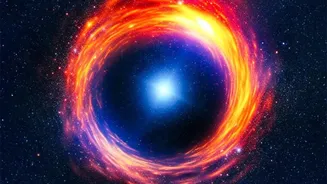
An MIT-led team, helmed by astronomer Rohan Naidu, has identified a completely new type of object that could change everything. While analyzing JWST data, they spotted an extremely bright, exceptionally red object from just 660 million years after the Big Bang. Dubbed MoM-BH*-1, it looks like a single, gigantic star the size of our solar system but shines with the energy of 100 billion suns—far more than any star could physically produce. Its unique light signature, which showed an extreme drop-off in brightness at certain wavelengths, couldn't be explained by ordinary stars. This led the researchers to a radical conclusion: they weren't looking at a star, but a 'black hole star'.
Inside a Black Hole Star
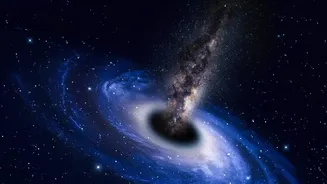
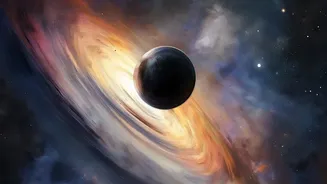
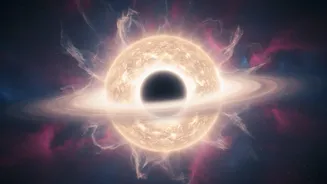
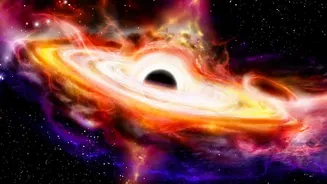
So what exactly is a black hole star? The team proposes it's a nascent supermassive black hole, already weighing around 100,000 times the mass of our sun, hidden inside a vast, dense envelope of pristine hydrogen gas. In this model, the intense energy isn't coming from nuclear fusion, like in a normal star, but from the black hole at its core rapidly accreting material from the gassy cocoon surrounding it. This thick, turbulent gas shroud effectively acts like a star's atmosphere, or photosphere, but on a colossal scale. The gas becomes superheated as it swirls toward the black hole, radiating the immense light that the JWST detected.
A Supercharged Growth Phase
This 'black hole star' phase could be the solution to the rapid growth problem. By being encased in such a dense, massive gas cloud, the young black hole has a constant, high-pressure fuel supply. This setup might allow it to bypass the normal Eddington limit, enabling a period of hyper-efficient, accelerated growth. Instead of slowly sipping from the interstellar medium, it's force-fed by its own massive gas envelope. This discovery could also explain the population of mysterious "little red dots" that the JWST has been spotting across the early universe. Naidu and his colleagues suggest that many of these could be black hole stars, indicating this was a common and crucial stage in the evolution of every massive black hole, including the one at the center of our own Milky Way galaxy.
Rewriting Cosmic History
This finding challenges the long-held notion that galaxies form first and their central black holes grow along with them. Instead, it suggests that in the early universe, the black holes may have gotten a significant head start, growing much faster than their host galaxies. The work of other MIT researchers, like Anna-Christina Eilers, supports this, showing that some of the earliest quasars (the bright cores of active galaxies powered by black holes) are far more massive relative to their host galaxies than what we see today. This new evidence for black hole stars provides a physical mechanism for how that initial, outsized growth could have happened. It paints a new picture of a chaotic early cosmos where giant, gas-shrouded black holes blazed brightly before settling down to become the anchors of the galaxies we see today.