




The Galaxy's Quiet Giant
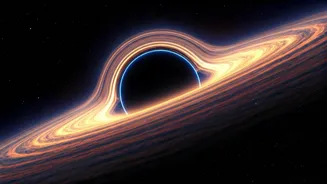
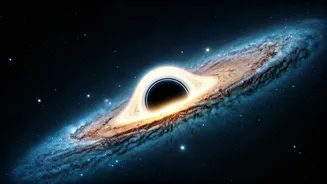
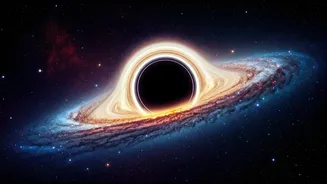
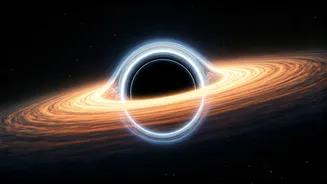
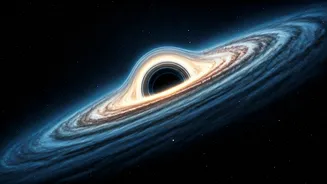
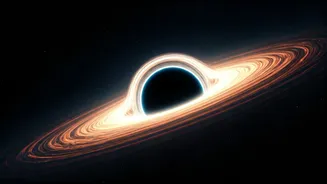
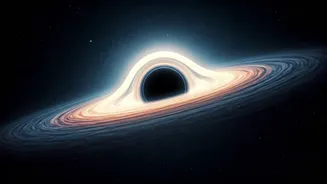
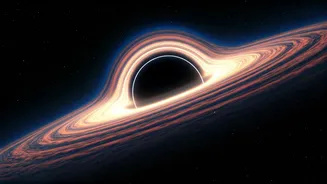
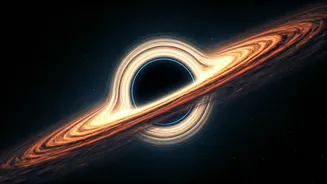
At the center of our Milky Way, about 26,000 light-years from Earth, sits Sagittarius A (Sgr A), a supermassive black hole with the mass of four million suns. For decades, scientists have understood a fundamental principle: when black holes feed on surrounding
gas and dust, they should also push material away in the form of powerful winds or jets. This happens because as matter swirls into a black hole, it heats up and releases immense energy, creating pressure that drives an outflow. While this has been observed with actively feeding black holes in distant galaxies, our own Sgr A has been a puzzle. It is remarkably quiet, consuming the equivalent of just one grain of rice every million years. Because it eats so little, any wind it produces was expected to be a gentle, elusive breeze.
A Frustrating Half-Century Search
The theory that black holes must produce winds has been around since the 1970s, not long after Sgr A itself was discovered. Scientists were confident that unless a black hole exists in a perfect vacuum—which doesn't exist in the universe—it has to generate a wind. Yet for 50 years, all attempts to find direct evidence of this wind near Sgr A came up empty. The view towards the galactic center is obscured by a thick curtain of gas, dust, and stars, making clear observations incredibly difficult. While some hints of past, stronger gales were found far from the black hole, confirming a presently active, gentle wind proved to be a monumental challenge. The lack of evidence made Sgr A seem like a strange outlier.
The Breakthrough Clue
The crucial discovery came from a team of astrophysicists at Northwestern University. Using five years of detailed observations from the Atacama Large Millimeter/Submillimeter Array (ALMA) in Chile, they created the sharpest-ever map of the cold gas surrounding the black hole. By developing a new technique to dim the intense radio glare from the black hole itself, they uncovered something remarkable: a giant, cone-shaped cavity in the gas, about three light-years long. This void, devoid of the cold gas seen everywhere else around it, was the unmistakable imprint of a wind. The team reasoned that a flow of hot gas from the black hole must have carved out this cavity, either by pushing the cold gas away or by heating it until it was no longer visible to the radio telescope.
Confirmation in X-Rays
To confirm their findings, the researchers turned to data from NASA's Chandra X-ray Observatory. If a hot wind was indeed clearing out the cold gas, then the cavity seen by ALMA should be filled with hot, X-ray-emitting gas. When they overlaid the Chandra data, the results were a perfect match. The bright X-ray emissions slotted perfectly into the cone-shaped void, dispelling any remaining doubt. Mark Gorski, a co-leader of the study, described the moment of realisation: "We looked at the data and said, 'There it is. There is the thing that everybody's been looking for for 50 years.'" This provided the first clean, direct view of the wind's imprint right near the black hole.
Why This Gentle Wind Matters
The discovery is more than just the solution to an old puzzle; it fundamentally deepens our understanding of how black holes and their host galaxies evolve together. Black hole winds play a crucial role in this cosmic dance. They can regulate a black hole's own growth by blowing away its food supply, and they can influence star formation across the galaxy by either compressing gas clouds to trigger new stars or blowing them apart. Because most supermassive black holes in the universe, like Sgr A*, spend their lives in a quiet state, observing this gentle breeze provides a vital look at their typical behaviour. It demonstrates that even when they are not actively feasting, these giants are constantly shaping their environment in subtle but significant ways, a process that may have been active for at least 20,000 years, according to the team's estimates.