




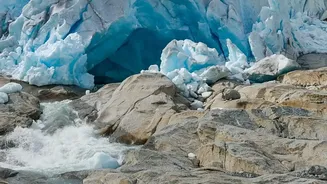
Greenland's Icy Gatekeeper
The Petermann Glacier is one of the largest and most significant glaciers in Greenland. It drains about four percent of the Greenland Ice Sheet, an immense frozen reservoir that, if it were to melt entirely, holds enough water to raise global sea levels
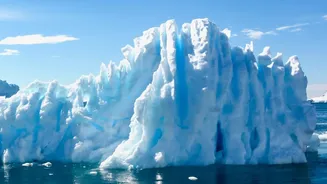
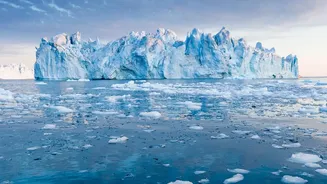
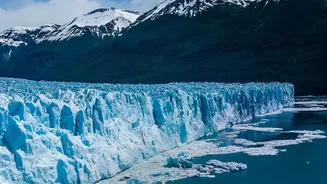
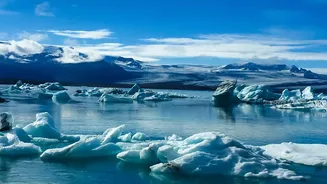
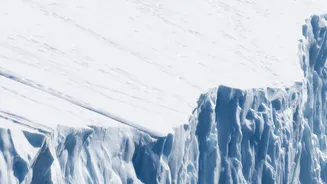
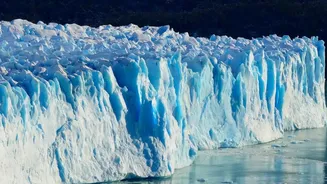
significantly. The glacier flows slowly towards the Arctic Ocean, and at its end, it doesn't just stop. Instead, it extends out over the water, forming a massive floating platform of ice known as an ice tongue or ice shelf. For years, this tongue stretched for tens of kilometres, a formidable and seemingly permanent fixture of the Arctic landscape.
What is a Floating Ice Tongue?
Imagine a river of honey flowing very, very slowly down a ramp. When it reaches a pool of water, it doesn't stop but spreads out over the surface. A glacier’s ice tongue is similar. It's the part of the glacier that has flowed past the “grounding line”—the point where the ice loses contact with the bedrock and begins to float on the ocean. While still connected to the main glacier on land, this floating extension is constantly in motion, pushed from behind by the inland ice and interacting with the ocean water below it.
The All-Important Braking Effect
The floating tongue’s most critical role is providing what scientists call a "buttressing effect". Think of it as a natural brake. The enormous ice tongue is wedged within a fjord, creating immense friction against the valley walls. This friction acts as a resistive force, effectively holding back the glacier behind it and slowing its march to the sea. Without this floating plug, the inland ice would be free to flow much more quickly. This buttressing is vital for the stability of the entire glacier system.
When the Cork Comes Out
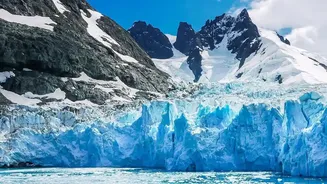
In recent decades, this natural brake has been failing. Warmed by a combination of rising air and ocean temperatures, the ice tongue has been thinning dramatically from below. This makes it more vulnerable to cracking. Major calving events, where enormous chunks of ice break off, have repeatedly shortened the tongue. Significant pieces broke off in 2010 and 2012. More recently, in August 2026, the glacier experienced its largest loss of floating ice in over a decade when a section roughly the size of Manhattan calved away. Each time a large piece breaks off, especially from the thicker ice closer to the grounding line, the buttressing effect is weakened. This is like loosening the cork in the bottle.
Accelerating the Flow to the Sea
When the floating tongue shrinks and the buttressing force is reduced, the glacier behind it accelerates. Multiple studies confirm that the loss of ice tongues can cause the glaciers that feed them to speed up their flow. While the calving of an already floating iceberg doesn't raise sea levels on its own (just as an ice cube melting in a glass of water doesn't make it overflow), the consequences are indirect and far more serious. The accelerated flow brings more ice from the grounded ice sheet into the ocean at a faster rate. This newly introduced ice then melts, adding vast quantities of freshwater to the world's oceans and directly contributing to global sea-level rise.
Why It Matters to India
A melting glacier in faraway Greenland might seem like a distant problem, but its effects are global. The water from Greenland's melting ice sheet doesn't stay in the Arctic. It redistributes across the planet, causing sea levels to rise everywhere. For a country like India, with over 7,500 kilometres of coastline and numerous low-lying cities like Mumbai, Kolkata, and Chennai, this is not a theoretical threat. Rising seas increase the risk of coastal flooding, erosion, and saltwater intrusion into freshwater sources, affecting millions of people, infrastructure, and agriculture. The stability of Petermann's ice tongue is therefore directly linked to the future security of coastal communities worldwide.