



A Puzzle in High-Energy Light
For years, astronomers have been intrigued by a peculiar source of very high-energy light, known as gamma rays. One such source, catalogued as HESS J1507−622, was first detected over a decade ago by telescopes in Namibia. It was strange because it was pumping
out powerful gamma rays without any corresponding light in lower energy forms, like X-rays or radio waves. Adding to the mystery, it was located away from the crowded plane of the Milky Way, where most known high-energy sources reside. This made it a cosmic anomaly. While some theories pointed to the remnants of a regular stellar explosion, or supernova, none quite fit the bill, leaving its true origin an open question.
Cosmic Ghosts: What Are Neutron Stars?
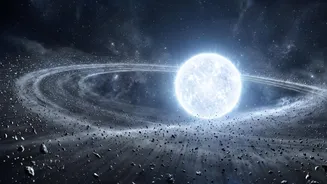
To understand the leading new theory, we have to journey to the most extreme corners of the universe. When a massive star, much larger than our sun, runs out of fuel, it collapses and explodes in a supernova. What's sometimes left behind is a neutron star—an object so incredibly dense that a teaspoon of its material would weigh billions of tons on Earth. These are the collapsed cores of giant stars, packing more mass than our sun into a city-sized sphere. Occasionally, two neutron stars are born orbiting each other. Over millions of years, they radiate energy away as gravitational waves, causing them to spiral closer and closer until they inevitably collide in a cataclysmic merger.
The 'Kilonova' Connection
The collision of two neutron stars is one of the most violent events in the cosmos, an explosion known as a 'kilonova'. This event unleashes a tremendous burst of energy and flings a cloud of neutron-rich material into space. This is where the universe forges its heaviest elements, like gold and platinum. A recent study proposes that just such an event is responsible for the mysterious gamma-ray glow. The idea is that a kilonova occurred long ago, blasting out cosmic rays—highly energetic particles. These particles have been travelling through space for thousands of years and are only now interacting with interstellar gas clouds in our galaxy. That interaction is what's causing the gas to light up, producing the specific gamma-ray glow that telescopes like the High Energy Stereoscopic System (HESS) have detected.
Why This Theory Is So Compelling
This neutron-star merger hypothesis elegantly solves several puzzles at once. It explains why the glow is seen only in high-energy gamma rays and not in other wavelengths, as the process doesn't create significant radio or X-ray signals. It also explains the source's isolated location. When neutron stars merge, they can get a gravitational 'kick' that flings the remnant out of the galaxy's main plane, which is consistent with where HESS J1507−622 is observed. According to the researchers behind the new hypothesis, the kilonova scenario consistently accounts for all the observed properties of the mysterious glow. It provides a coherent narrative, connecting a past, unseen cataclysm to a present-day cosmic puzzle.