



A Warning on Strategic Dependencies
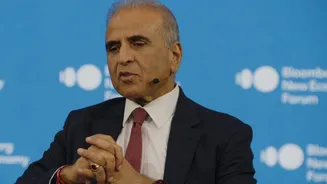
Speaking at the recent Bloomberg New Economy Forum, Ashwini Vaishnaw, the Union Minister for Electronics and IT, was clear: India's quest for technological sovereignty faces a major hurdle in its dependence on imported critical materials. He stressed
that building a resilient semiconductor industry is not just about establishing massive fabrication plants, or 'fabs'. It is equally, if not more, about controlling the supply of the foundational elements that go into them. Vaishnaw clarified that the goal isn't total isolation, but identifying and mitigating strategic dependencies that could expose India's economy to geopolitical shocks and supply chain disruptions. This perspective shapes India’s long-term, 20-25 year strategy for building true economic and technological resilience.
The Ecosystem's Hidden Backbone
A modern semiconductor fab is one of the most complex manufacturing environments on Earth, but it is fundamentally a massive, ultra-precise chemical processing plant. Vaishnaw’s warning puts a spotlight on this often-overlooked part of the supply chain. He emphasized the need to develop domestic capabilities in producing and handling specialty chemicals, industrial gases, and substrate materials. As he noted, 'Without an ecosystem, no manufacturing effort will ever pay off'. This ecosystem includes not just the primary raw materials like silicon, but a vast array of other inputs. The global supply chains for many of these are highly concentrated in a few countries, creating significant risk. A disruption in the supply of even one critical gas or chemical could bring a multi-billion dollar fab to a standstill.
More Than Just Silicon
While silicon is the bedrock of the chip industry, it is far from the only material required. Manufacturing advanced semiconductors involves hundreds of steps using a cocktail of highly specialized inputs. These include compound semiconductor materials like Gallium Nitride (GaN) and Silicon Carbide (SiC), which are vital for high-power and high-frequency applications such as in electric vehicles and 5G technology. The process also consumes vast quantities of ultra-pure industrial gases (like neon, argon, and xenon) and wet chemicals (like high-purity acids and solvents) for etching and cleaning wafers. Furthermore, materials like photoresists are essential for the lithography process that patterns the chips. The refining and production of many of these materials are dominated by a handful of global players, creating the very vulnerabilities Vaishnaw highlighted.
India's Strategic Response
The Indian government is actively shifting its strategy to address these weaknesses. The India Semiconductor Mission (ISM) is evolving, with its second phase, dubbed 'Semicon 2.0', placing a greater emphasis on building this complete ecosystem. With an approved outlay of over ₹1.27 lakh crore, the program aims to bolster the entire value chain, from design and materials to fabrication and advanced packaging. The strategy is to systematically progress up the value chain, moving from assembly to producing components, and finally, the crucial raw materials and capital equipment. This involves creating dedicated industrial zones for chemical production and forging trusted international partnerships to diversify supply sources and facilitate technology transfer.
The Long Road to Self-Reliance
Achieving resilience in the semiconductor material supply chain is a marathon, not a sprint. Vaishnaw acknowledged that countries currently dominating this space have invested decades in building their expertise. India must now accelerate this process. The challenges are immense, requiring not just massive capital investment but also deep R&D capabilities, a highly skilled workforce, and robust infrastructure for handling hazardous materials. The government's focus on a long-term roadmap signals an understanding that building this foundational layer of the tech economy is a complex, generational effort. It is a non-negotiable step to ensure that India’s growing prowess in chip design is matched by a secure and stable manufacturing base, turning ambition into sustainable industrial might.