





A Major Leap in Chennai
On September 8, 2026, Agnikul Cosmos officially opened two new centres at its Chennai assembly and testing facility. The event was significant enough to be attended by Group Captain Shubhanshu Shukla, one of the astronauts designated for India's Gaganyaan
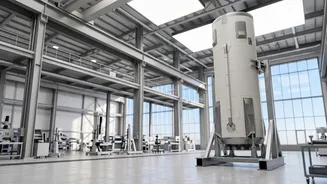
mission. These are not just any buildings; they represent a critical leap in India's private space journey. The new units are the Stage Testing & Inspection Facility (STIF) and the Pressurant Tank Realisation, Over-wrapping and Outfitting Facility (PROOF). Together, they give Agnikul the end-to-end capability to build, test, fly, recover, inspect, and requalify rocket stages for another mission. This makes it the only private Indian company with the infrastructure for post-flight requalification.
Why Reusability is the Holy Grail
For decades, rockets were an expensive, one-and-done deal, like throwing away an airplane after a single flight. Reusability, pioneered by companies like SpaceX, changed everything. By recovering and relaunching rocket boosters, the cost of accessing space plummets. This is the key to a sustainable and bustling space economy. Agnikul's new STIF facility is designed specifically to chase this goal. It allows engineers to test entire rocket stages under flight-like conditions, including full-duration engine burns of up to 150 seconds. More importantly, it is where recovered stages will be inspected and certified to fly again, establishing the complete cycle needed for a reusable launch system.
Vertical Integration and In-House Power
Beyond testing, the new PROOF facility is a strategic move towards self-reliance. It allows Agnikul to manufacture its own high-pressure composite overwrapped pressure vessels (COPVs), critical components that hold pressurised gases and liquids. By bringing this production in-house, Agnikul reduces its dependence on external suppliers, gaining control over quality and speeding up production timelines. This vertical integration is a hallmark of modern space companies. Agnikul already designs and manufactures its own unique, single-piece 3D-printed semi-cryogenic engines, and these new facilities add another layer of in-house capability.
Agnibaan and the Road Ahead
This infrastructure is all in service of Agnikul's flagship launch vehicle, Agnibaan, a customisable rocket designed for the booming small satellite market. The company achieved a major milestone in May 2024 with the successful sub-orbital flight of its 'SOrTeD' demonstrator, which validated its 3D-printed engine and in-house autopilot systems. The next step, Mission-02, is even more ambitious. It's planned to feature an attempt at an ocean recovery of the rocket's first stage, a crucial step towards reusability. The new Chennai facilities provide the necessary ground infrastructure to support these increasingly complex missions, moving the company from successful tests to a repeatable commercial launch service.
Fueling India's Private Space Race
Agnikul's expansion is not happening in a vacuum. It's a key development in India's broader push to become a global space hub, encouraging private companies to build, innovate, and launch. As noted by Group Captain Shukla at the inauguration, capabilities like these are vital for building a deeper and more self-reliant space ecosystem for India. The new facilities position Agnikul among a very small group of companies globally that are working towards full-stack reusable launch capability. This not only enhances the startup's competitive edge but also signals to the world that India's private space sector is ready for the big leagues, moving from ambitious plans to concrete, world-class hardware.