


One Name, One Mission
Contrary to early speculation, the 'Skyfall' mapping of subsurface ice and the 'Skyfall' helicopter concept are not two separate projects that coincidentally share a name. They are two deeply integrated components of a single, ambitious NASA mission officially
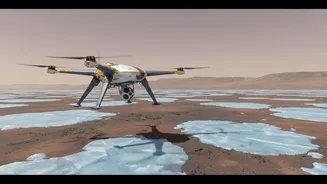
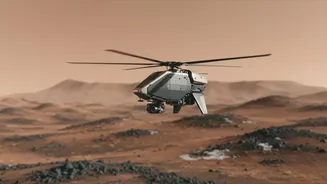
announced in March 2026. The Skyfall mission will send a trio of advanced helicopters to Mars, building on the legacy of the groundbreaking Ingenuity drone. However, their purpose goes far beyond simply proving that flight is possible. These new helicopters are scientific tools, and their primary job is one of the most crucial for future human exploration: finding water.
The Skyfall Helicopters: Aerial Treasure Hunters
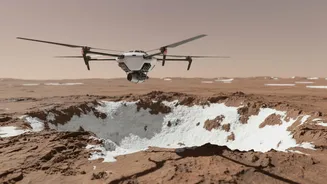
The Skyfall mission will deploy three helicopters that are an evolution of the Ingenuity design. They are designed for mid-air deployment after entering the Martian atmosphere. Each helicopter is equipped with a suite of scientific instruments, but the star of the show is a compact, ground-penetrating radar (GPR). This technology is designed to peer into the first few meters below the Martian surface, a critical zone that orbiters struggle to analyze in detail. This allows the helicopters to hunt for shallow deposits of subsurface water ice, a resource vital for future astronauts who could process it for drinking water, breathable oxygen, and even rocket fuel.
A Cape-Like Antenna for Subsurface Scouting
The ground-penetrating radar requires a unique antenna. To get a clear view of the ground, the antenna must extend below the helicopter, but it also needs to survive repeated landings in the rugged Martian terrain. The engineering solution is a flexible, fabric-based antenna that has been described as looking like a tiny 'cape'. This innovative design allows the antenna to bend upon landing and spring back into its required shape after takeoff. Made of durable materials like polyester and Vectran, it's a clever solution that enables the helicopters to perform their ice-hunting duties flight after flight. By flying low and slow, these caped crusaders can create high-resolution maps of ice deposits that will be invaluable for planning future landing sites.
Beyond Ice Mapping
While mapping subsurface ice is the headline task, the Skyfall mission's objectives are broader. The helicopters will also demonstrate advanced scouting and aerial mapping capabilities to identify safe and resource-rich destinations for future human missions. Unlike Ingenuity, which had to relay communications through the Perseverance rover, the Skyfall helicopters will be able to transmit their findings independently to orbiting spacecraft, giving them greater operational range and flexibility. This mission represents a significant step up from a technology demonstration to a full-fledged aerial science and reconnaissance platform, paving the way for a new era of Martian exploration.
The Road to Mars
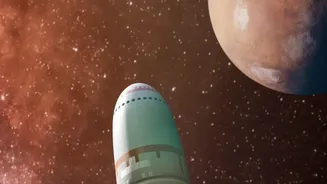
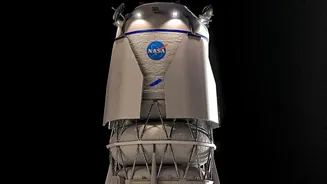
The Skyfall mission is not just a concept; it's a funded program with a target launch date of late 2028. The mission will be delivered to Mars by a novel spacecraft called Space Reactor-1 (SR-1) Freedom, which will itself be a demonstration of advanced nuclear electric propulsion. This highlights the strategic importance NASA places on the mission's goals. Private industry is also heavily involved. AeroVironment, which helped build Ingenuity, is co-designing the Skyfall helicopters, while Firefly Aerospace has been contracted to build the aeroshell that will protect the payload during its fiery entry into the Martian atmosphere. This public-private partnership is key to making such an advanced mission a reality.