







A Discovery Born from Routine
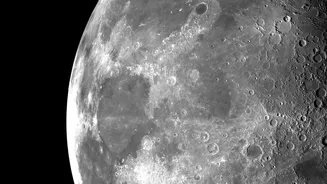
It all started with a routine data check. Robert Wagner, an image-processing specialist working with data from NASA’s Lunar Reconnaissance Orbiter (LRO), was scanning a map of the Moon when an unusually large, bright spot caught his eye. Surrounded by
a dark halo, the feature suggested the surface had been recently disturbed. By comparing 'before' and 'after' images captured by the LRO, Wagner confirmed he had found a new impact crater. The impact itself occurred sometime between April and May of 2024, but the crater wasn't spotted in the vast amount of data until later. This wasn't just any crater; it was the largest newly formed crater ever identified by the LRO mission, which has been mapping the Moon for over a decade.
The 'Once-in-a-Century' Impact
The new feature, officially named McGetchin crater after pioneering lunar scientist Tom McGetchin, is immense. It measures about 728 feet (222 meters) across and is 141 feet (43 meters) deep, capacious enough to fit Rome's Colosseum inside or three school buses stacked vertically. Scientists estimate an impact of this magnitude happens on the Moon only about once every century, making this a statistically rare, once-in-a-lifetime observation. The object that struck the Moon was likely an asteroid or comet fragment the size of a three-to-six-story building. While the Moon is constantly bombarded by smaller objects, with around 140 new craters the size of a coffee table appearing each year, an impact of this scale is exceptionally uncommon.
More Than Just a Hole
This discovery is far more significant than just a new pockmark on the lunar surface. Fresh craters act like natural excavation sites, digging up pristine material from beneath the Moon's surface that hasn't been weathered by the harsh space environment. The bright material, or ejecta, thrown out from the McGetchin crater provides a clean sample of the Moon's subsurface for scientists to study from orbit. Furthermore, the LRO's instruments detected a four-mile-wide 'cold spot' around the crater. The impact 'fluffed up' the lunar soil, or regolith, making it less dense and less able to retain heat overnight. This shows that a large impact can alter the physical properties of the lunar surface far beyond the crater's rim, a crucial detail for planning future robotic and human missions.
Why This Crater Matters for the Future
For NASA and other space agencies planning a sustained human presence on the Moon, understanding the current impact environment is critical. The McGetchin crater provides a perfect, real-world data point for calibrating the risk models that keep astronauts and equipment safe. It helps answer a vital question: how often does the Moon get hit by objects large enough to pose a significant threat? By studying the crater's formation and its widespread effects on the surrounding terrain, scientists can better predict the consequences of future impacts. The long-term monitoring by the LRO, which has now identified over 1,000 new craters, proves invaluable in painting a picture of the Moon not as a static, unchanging world, but as a geologically active body.