






The Star-Sized Deception
When astronomers study a distant planet, or exoplanet, they often use the 'transit method'. This involves watching the planet pass in front of its host star and analyzing the starlight that filters through the planet's atmosphere. Gases in the atmosphere,
like water vapour, absorb specific wavelengths of light, leaving a chemical fingerprint that powerful telescopes can detect. However, stars are not perfect, uniform spheres of light. They have active, splotchy surfaces with cooler, dark starspots and hotter, bright regions called faculae. This stellar activity can create false signals that mimic or hide the very atmospheric features scientists are looking for, a problem known as stellar contamination. This has led to uncertainty in past findings, with some signals initially attributed to water on a planet later being questioned as potential interference from the star itself.
Enter Pandora: A Focused Solution
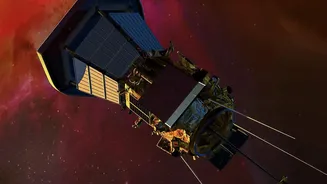
To tackle this specific and vexing issue, NASA developed the Pandora mission. Launched in January 2026, it's a SmallSat—a low-cost, refrigerator-sized satellite—and the first to launch under the agency's Astrophysics Pioneers program. This program is designed for agile missions that can address focused scientific questions. Pandora’s mission isn't to survey thousands of new worlds, but to conduct an in-depth study of at least 20 known exoplanets and their host stars during its year-long primary mission. The project is a collaboration between NASA's Goddard Space Flight Center, Lawrence Livermore National Laboratory, and other institutions, all working to provide clear data for the astronomical community.
How It Untangles the Signals
Pandora's cleverness lies in its dual-pronged approach. The spacecraft is equipped with an 18-inch aluminum telescope that observes its targets in two ways at once. It uses a visible light detector to monitor the star’s brightness and track changes on its surface, like the rotation of starspots. Simultaneously, its near-infrared spectrograph—which cleverly uses a spare detector originally built for the James Webb Space Telescope (JWST)—measures the starlight passing through the planet’s atmosphere. By observing in both visible and infrared light for long periods, often 24 hours at a time, scientists can create a model of the star's activity. This allows them to precisely subtract the star's 'noise' from the transit data, isolating the true atmospheric signal from the planet.
A Pathfinder for Webb and Beyond
Pandora isn't designed to be a replacement for behemoths like the JWST; instead, it's a vital complement to them. While JWST has unparalleled power to deeply analyze atmospheres, its time is incredibly valuable and it can't always distinguish planetary signals from stellar ones on its own. Pandora acts as a pathfinder, performing the time-intensive work of creating a clean, vetted list of high-priority targets. By providing robust data on which planets have clear, water-rich atmospheres versus those obscured by clouds, hazes, or stellar activity, Pandora helps scientists use the limited time on major observatories much more efficiently. The results from this small but crucial mission will provide a stronger foundation for the ongoing search for habitable worlds, ensuring that when we look for signs of life, we can be confident in what we see.