

A Surprising Discovery in Acid
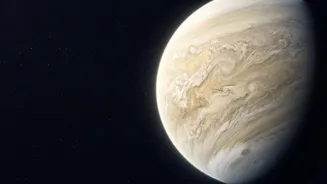
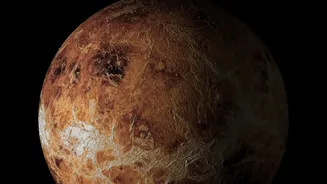
The latest buzz comes from a study by researchers at MIT, who investigated a long-standing question: could the building blocks of life survive in the intensely acidic clouds of Venus? It was widely assumed that the cloud droplets, composed of about 98%
sulfuric acid, would instantly destroy any complex organic molecules. The new findings, published in early September 2026, turn that assumption on its head. Scientists found that peptides, which are short chains of amino acids that form the basis of proteins, do not just survive in concentrated sulfuric acid—they remain stable for weeks. Even more surprisingly, they fold into specific three-dimensional shapes, a critical property for them to perform biological functions.
What Exactly Is Prebiotic Chemistry?
This new research is a major development in the field of prebiotic chemistry. But what does that term mean? In simple terms, prebiotic chemistry is the study of the chemical steps that happened before life began. Think of it as the process of gathering and preparing ingredients before you can bake a cake. Life as we know it relies on a complex network of molecules like DNA, RNA, and proteins. Prebiotic chemistry explores how the basic building blocks of these molecules—compounds like amino acids and nucleotides—could have formed from simpler chemicals present on a young planet. It’s the crucial bridge between a non-living planet and the first stirrings of biology.
Why the Focus on Venus's Clouds?
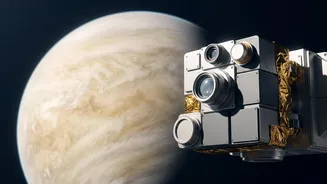
While the surface of Venus is a furnace, conditions are dramatically different higher up. In a layer of the atmosphere between 48 and 60 kilometres above the ground, the temperature and pressure are surprisingly similar to those found on Earth. This has led some scientists to speculate for years that this temperate cloud layer could be a potential haven for microbial life. The main obstacle has always been the chemistry. The clouds are not made of water like on Earth, but of highly corrosive sulfuric acid. The question was whether any of life's essential chemistry could function in such an extreme solvent. This is precisely the question the new MIT study sought to answer.
A New Recipe for Life?
The stability of peptides in acid is significant because it suggests that the chemical rulebook for life might be broader than we thought. Much of life on Earth is water-based. In fact, the presence of water helps break the bonds that hold peptides together in a process called hydrolysis. The new study suggests that the extreme lack of water in the sulfuric acid clouds might ironically protect these molecules, allowing them to exist and hold their shape. Meteorites are known to deliver amino acids to planets, so the raw ingredients could be present in Venus's atmosphere. This finding shows that once there, they wouldn't necessarily be destroyed, opening a new pathway for prebiotic chemistry to occur.
Caution and Next Steps
It is crucial to be clear: this research does not prove that life exists on Venus. What it does is challenge a key argument against its possibility, showing that complex organic molecules can be stable where we thought they could not. The scientists behind the study are careful to make this distinction. Their work shows that a fundamental requirement for life—the stability of its building blocks—is met, but it doesn't demonstrate that those blocks have assembled into living organisms. The next steps for researchers will be to see if longer, more complex chains of amino acids and other molecules related to genetics, like peptide nucleic acids (PNA), can also remain stable and structured in Venus-like conditions.