




The Date Was Advanced by a Year
The British initially planned to transfer power to India by June 30, 1948. However, the last Viceroy, Lord Mountbatten, decided to advance the date to August 15, 1947. He argued that the escalating political unrest and communal tensions between the Congress
and the Muslim League made an earlier transfer of power necessary to avoid a total collapse of the interim government. The date itself had a personal significance for Mountbatten: it marked the second anniversary of Japan's surrender to the Allied forces in World War II, a moment he considered lucky for his career.
Gandhi Was Absent from the Celebrations
While New Delhi erupted in celebration on August 15, 1947, Mahatma Gandhi, the Father of the Nation, was conspicuously absent. He was in Calcutta (now Kolkata), undertaking a fast to protest the horrific communal violence that had broken out in the wake of Partition. For Gandhi, who had dedicated his life to Hindu-Muslim unity, the division of the country was a cause for mourning, not celebration. Lord Mountbatten himself acknowledged Gandhi's immense impact, referring to him as a 'one-man boundary force' for his success in quelling the riots in Bengal.
India Had No National Anthem on Day One
When India gained independence, it did not have an official national anthem. Rabindranath Tagore's 'Jana Gana Mana' was written in 1911 and had been sung at political gatherings, but it was not formally adopted by the Constituent Assembly until January 24, 1950. On the morning of August 15, 1947, another famous patriotic song, 'Vande Mataram', was sung on All India Radio at the request of Sardar Vallabhbhai Patel. 'Jana Gana Mana' was chosen as the anthem just two days before India became a republic.
The Indo-Pak Border Was Announced Late
The fate of millions was sealed by the Radcliffe Line, the boundary that divided British India into India and Pakistan. This line was drawn by British lawyer Sir Cyril Radcliffe, who had very little prior knowledge of India. The boundary was finalized on August 12, 1947, but it was not officially published until August 17, two full days after independence. This delay meant that for millions of people living in the border provinces of Punjab and Bengal, there was immense confusion and uncertainty about which country their homes would belong to, exacerbating the chaos and violence of Partition.
Goa Remained a Portuguese Colony
While India celebrated its freedom from British rule, several territories on the subcontinent remained under foreign control. The most significant of these was Goa, which was a Portuguese colony for about 450 years. Despite India's requests for a transfer of sovereignty after 1947, Portugal refused to negotiate. It wasn't until December 19, 1961, that the Indian Army launched 'Operation Vijay' to annex Goa, Daman, and Diu into the Indian union, finally ending the last vestiges of European colonialism on Indian soil.
The Tricolour Was Adopted Just Before Independence
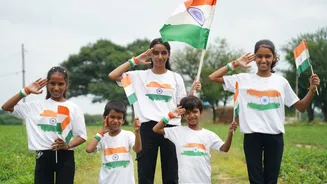
The Indian tricolour, in its present form, was adopted by the Constituent Assembly on July 22, 1947, only a few weeks before independence. The flag's design evolved over several decades. An early version hoisted in 1906 had stripes of red, yellow, and green. The design proposed by Pingali Venkayya in 1921 initially had two colours, red and green, to represent Hindus and Muslims, with Mahatma Gandhi later suggesting the addition of a white stripe for other communities and a spinning wheel. For the final version, the spinning wheel was replaced by the Ashoka Chakra (Wheel of Law).
India Was a 'Dominion' Until 1950
For the first two and a half years of its existence, from August 15, 1947, to January 26, 1950, India was a 'Dominion' within the British Commonwealth. This meant that while it was independent and self-governing, King George VI remained the formal head of state, and the country was led by a Governor-General (Lord Mountbatten being the first). This transitional phase ended when India adopted its constitution and became a sovereign, socialist, secular, and democratic republic with a president as its head of state.
Over 500 Princely States Had to Be Integrated
The end of British rule also meant the end of their authority over more than 500 princely states. These states, varying greatly in size and population, were technically granted the choice to join India, join Pakistan, or remain independent, posing a serious threat of fragmenting the country. It was the monumental task of Sardar Vallabhbhai Patel, ably assisted by V.P. Menon, to persuade and negotiate with these rulers to accede to India. Through tireless diplomacy and, in some cases, firm action, they successfully integrated these states into the Indian Union.
Lord Mountbatten Served as the First Governor-General
In a unique turn of events, the last British Viceroy, Lord Mountbatten, was invited to stay on as the first Governor-General of independent India. Jawaharlal Nehru made the request, and Mountbatten served in this capacity from August 15, 1947, until June 1948. His role during this period was crucial in managing the transition, overseeing the integration of the princely states, and helping to stabilize the new government amidst the turmoil of Partition.
Pakistan's Independence Day Was Also August 15 Initially
The Indian Independence Act of 1947 set August 15 as the independence date for both India and Pakistan. In fact, Pakistan's founder, Muhammad Ali Jinnah, in his first broadcast to the nation, declared August 15 as the "birthday of the independent and sovereign state of Pakistan." However, since Lord Mountbatten had to attend the transfer of power ceremony in Karachi on August 14 before returning to Delhi for the midnight ceremony, Pakistan later shifted its national day to August 14. This decision was formally made in June 1948.