







A Signal from the Void
On July 7, 2026, mission controllers at the Johns Hopkins Applied Physics Laboratory (APL) in Maryland confirmed they had received a signal from the distant probe. The message, travelling at the speed of light, took nearly nine hours to cross the vast
distance separating the spacecraft from Earth. This signal confirmed that New Horizons had successfully executed pre-programmed commands to exit a long hibernation period that began in August 2025. According to Mission Operations Manager Alice Bowman, all status reports throughout the hibernation were 'green,' indicating the probe remained in perfect health while dormant.
A Necessary Rest for a Veteran Explorer
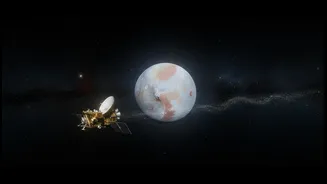
This wasn’t the probe's first nap. Mission planners routinely place New Horizons into hibernation to conserve its finite power and protect its electronic systems during the long, uneventful cruise phases between points of interest. Launched in 2006, New Horizons is the fastest human-made object ever launched from Earth. Its primary mission was the historic flyby of Pluto in 2015, which transformed our understanding of the dwarf planet. In 2019, it made history again by visiting Arrokoth, the most distant object ever explored up close by a spacecraft. Hibernation extends the life of its nuclear power source—a Radioisotope Thermoelectric Generator—ensuring it has enough energy for future scientific observations.
Exploring the Solar System's 'Twilight Zone'
New Horizons is currently traversing the Kuiper Belt, a vast, doughnut-shaped region beyond the orbit of Neptune filled with icy bodies, dwarf planets, and remnants from the formation of our solar system. This distant realm is a scientific treasure trove, holding clues to the solar system's ancient past. Even while hibernating, some of the probe's instruments continued to collect data, including measurements of the solar wind and the dust environment in this largely unexplored territory. Scientists are particularly interested in this data as it helps them understand the boundary where the Sun's influence, or heliosphere, begins to fade.
What's Next for New Horizons?
With the spacecraft now fully active, engineers will first download the stored health and safety data before retrieving the science observations gathered during its long sleep. The probe's instruments, including its ultraviolet spectrograph and plasma sensors, will resume their study of the Kuiper Belt environment. A key, though challenging, goal of the extended mission is to find another suitable Kuiper Belt Object (KBO) for a close flyby. While no target has been identified yet, the search continues. Finding a small, dark object in the vastness of space from billions of kilometres away is an immense challenge, but the scientific payoff would be extraordinary. The mission is currently funded to continue through 2028 or 2029, as it makes its way toward interstellar space.