

A Star's Explosive Finale
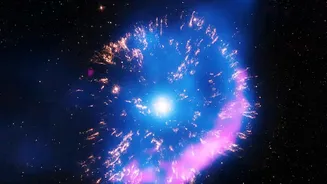
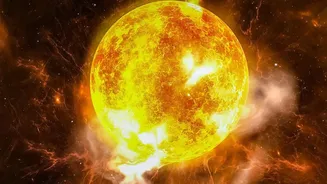
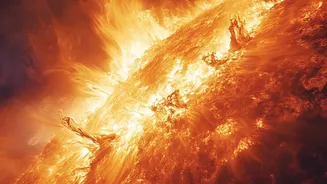
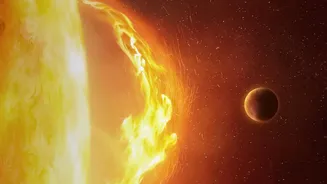
Imagine a star many times more massive than our Sun reaching the end of its life. Having burned through its fuel for millions of years, the outward pressure from nuclear fusion can no longer hold back the immense force of its own gravity. The star’s core
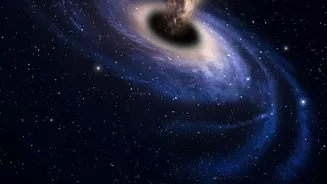
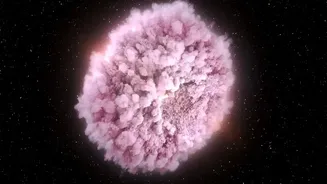
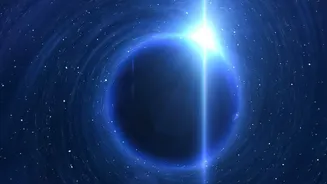
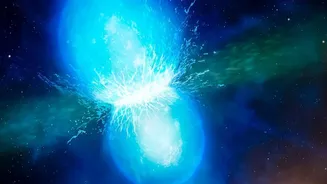
implodes in a fraction of a second, an event known as a core-collapse supernova. This catastrophic event is one of the most powerful in the universe, releasing unfathomable amounts of energy. For decades, astrophysicists have tried to understand the precise mechanics that follow this collapse. The central question has always been what determines the final remnant: is it a super-dense neutron star, or does gravity win completely, creating a stellar-mass black hole? The answer, it seems, may lie with the universe's most elusive particles.
The Cosmic Crossroads
Predicting whether a collapsing star will explode or simply vanish into a black hole has been a major challenge. For a long time, scientists believed a star's initial mass was the primary factor. However, observations have presented a more complicated picture. Astronomers have seen fewer supernovas than theories predict and have even witnessed massive stars seemingly disappearing without a trace, presumably collapsing directly into black holes. This suggests other factors are at play. A recent study from the University of Copenhagen took a closer look at one of these hidden variables: neutrinos. By simulating the deaths of 195 stars, with masses ranging from nine to 120 times that of our Sun, researchers explored how these tiny particles could tip the scales.
Enter the 'Ghost Particle'
Neutrinos are fundamental particles with almost no mass and no electric charge, which allows them to pass through most matter as if it were not there—earning them the nickname 'ghost particles'. During a star's core collapse, a staggering 99% of the released energy is carried away by a massive flood of neutrinos. While most escape, a small fraction interact with the material just outside the core, heating it. This neutrino heating is believed to provide the crucial push needed to power the outward supernova explosion. Without it, the explosion would likely fail, and the star would continue collapsing into a black hole. A small change in how these neutrinos behave can, therefore, decide the entire star's destiny.
A Surprising Discovery in the Simulations
The new study focused on a peculiar property of neutrinos known as 'flavour conversion,' where the particles can switch between their three types: electron, muon, and tau. Previously, it was often assumed that this process had a negligible effect on the outcome of a supernova. The researchers ran their 195 simulations both with and without flavour conversion factored in. The results were startling. They found that for a significant number of stars, particularly those between 16 and 30 times the mass of the Sun, including neutrino flavour conversion flipped the predicted outcome. Stars that were expected to explode as supernovas instead failed and collapsed into black holes. According to lead author Mariam Gogilashvili, seeing this clear pattern proved that neutrino physics cannot be ignored in stellar models.
Why This Changes Everything
This breakthrough provides a potential explanation for several long-standing cosmic mysteries. The 'missing' supernovas and disappearing stars that have puzzled astronomers might be the very ones whose fates were altered by neutrino flavour changes. It could also help explain why some observed neutron stars have lower masses than theories previously predicted. By incorporating this refined understanding of neutrino physics, scientists can build more accurate models of stellar evolution and the life cycles of massive stars. It brings us one step closer to understanding how the universe creates its most extreme objects and how it distributes the heavy elements—forged in supernova explosions—that are essential for forming planets and life. This research highlights how the physics of the incredibly small can dictate the outcomes of the most colossally large events in the cosmos.