


The Super-Earth Mystery
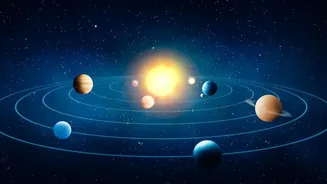
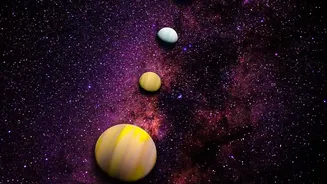
When astronomers gaze out into the galaxy, they find 'Super-Earths' everywhere. These are planets larger than Earth but smaller than Neptune, typically five to ten times our planet's mass, and they are one of the most common types of planets discovered
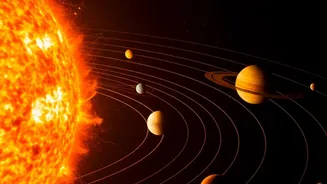
around other stars. Yet, in our own solar system, there are none. This has long been a puzzle for scientists. Did our solar system just happen to form without one, or was there a Super-Earth that has since vanished? A recent theory proposes a dramatic answer: our Sun may have swallowed it.
A Planet for Breakfast
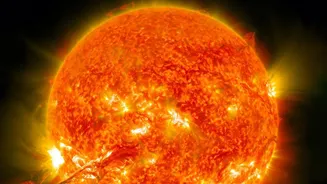
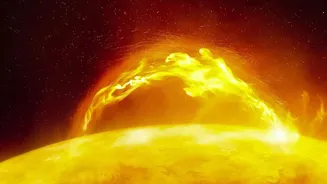
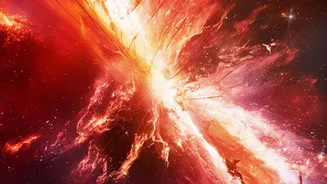
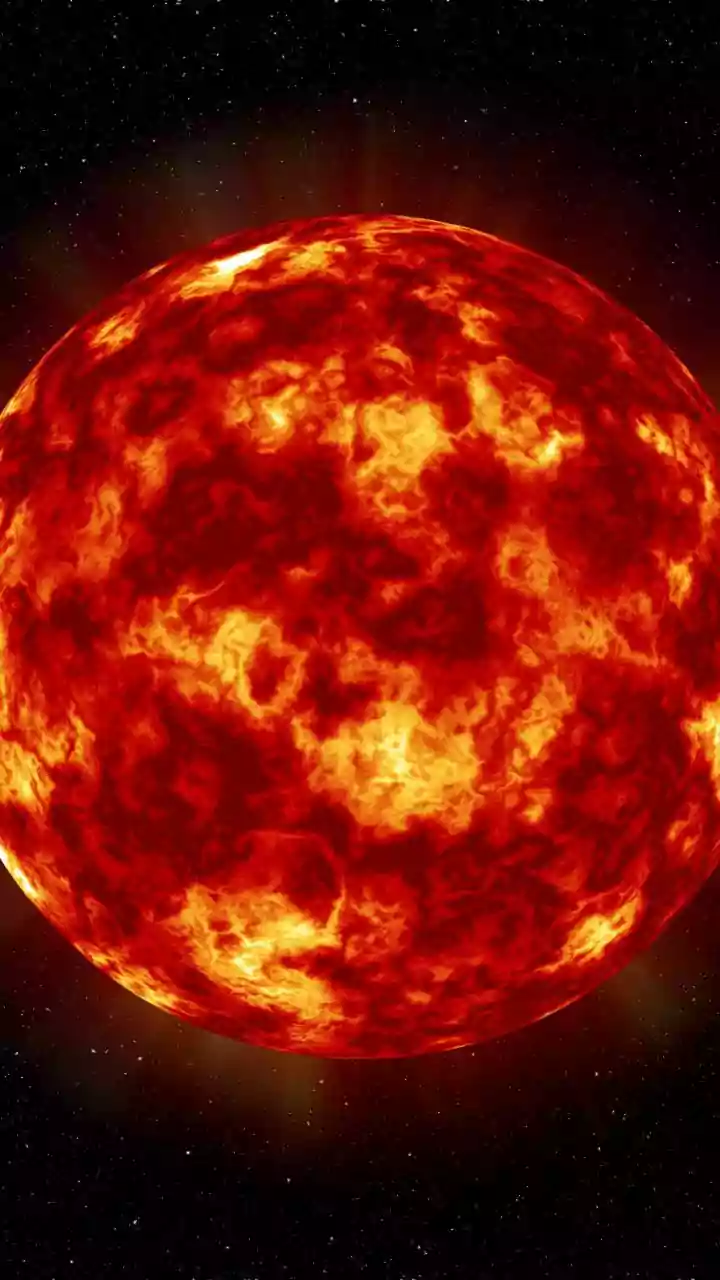
New research published in the Monthly Notices of the Royal Astronomical Society suggests that one or more Super-Earths could have formed very close to our young Sun. In the chaotic early days of the solar system, the protoplanetary disk—a swirling ring of gas and dust—would have exerted a drag on these nascent worlds. According to computer models, this drag could have caused a planet several times the mass of Earth to spiral inward on a collision course with the Sun. This event, a star swallowing one of its own planets, could explain the conspicuous absence of Super-Earths in our cosmic neighborhood.
Fingerprints Left Behind
A planet plunging into a star wouldn't just disappear without a trace. Researchers propose that such a cataclysmic event would leave lasting 'fingerprints' on the Sun's chemical composition and internal structure. The material from the engulfed planet could have penetrated deep into the star, altering its elemental makeup in ways we might still be able to detect today. For instance, one of the enduring puzzles about the Sun is its surprisingly low amount of lithium. An engulfed planet could potentially explain this chemical anomaly and other discrepancies between solar models and reality. According to Professor Mutlu Yildiz of Ege University, a planet several times more massive than Earth falling into the young Sun could have left a lasting chemical imprint deep inside it.
Echoes of Planet Vulcan
The idea of a planet orbiting inside Mercury's path is not new. In the 19th century, astronomers puzzled over Mercury's strange, wobbly orbit, which didn't perfectly match the predictions of Newtonian physics. The French mathematician Urbain Le Verrier, famous for predicting the existence of Neptune, hypothesized that a hidden planet, which he named 'Vulcan', was gravitationally tugging on Mercury. For over 50 years, astronomers hunted for Vulcan, with some even claiming to have seen it. The mystery was only solved in 1915 when Albert Einstein's theory of general relativity showed that the Sun's immense gravity warps spacetime, accounting for Mercury's orbital precession perfectly without the need for another planet. While that particular Vulcan was disproven, the idea of a lost inner planet has been reborn.
Solving the Mercury Problem
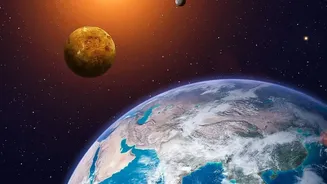
Beyond just its orbit, Mercury is an oddball planet. It has a massive iron core that makes up about 70% of its mass, far larger than that of Earth, Venus, or Mars. For a long time, the leading theory was that a proto-Mercury was struck by a massive object in a hit-and-run collision that stripped away most of its rocky mantle, leaving the dense core behind. While the idea of a cataclysmic impact shaping Mercury is widely accepted, the specifics are debated. The former presence of a nearby Super-Earth, and the gravitational chaos it would have created before its demise, adds another layer to understanding the violent history that shaped the strange, tiny world we see today. The early solar system was a shooting gallery, and the evidence suggests Mercury took some of the biggest hits.