






A Castle in the Clouds
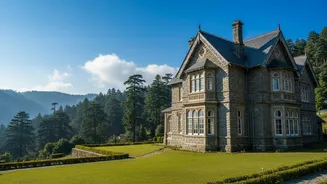
Formerly known as Government House, and now as Raj Bhavan, the building is a breathtaking example of colonial-era design. Its construction began in 1897 and took two years to complete, intended to serve as the summer residence for the British governors
of the North-Western Provinces. Spread across a sprawling estate of over 200 acres, the two-storeyed mansion, with its turrets and towers, cuts a dramatic silhouette against the Himalayan sky, designed specifically to project an image of imperial power and permanence in the cool mountain air. The sheer scale and European design can feel startlingly out of place, yet it has become one of Nainital's most iconic and beloved landmarks.
The Architect's Vision
The design was the brainchild of architect F.W. Stevens, who was a prominent figure in Indo-Saracenic and Gothic revival architecture in India. For the Governor's House, he chose a Victorian Gothic style, sometimes referred to as Domestic Gothic, reminiscent of a Scottish castle or an English country estate. The style is characterized by its pointed arches, castellated turrets, and elaborate detailing. The entire structure was meticulously planned, with the engineer F.O.W. Ortel overseeing the challenging construction on the hilly terrain. The goal was not just to build a residence but a statement piece, a symbol of British authority designed to impress and endure.
Craftsmanship in Stone and Wood
The grandeur of the building is rooted in its materials. The structure was primarily built using local dark grey marble and dolomite limestone, giving it a formidable and stately appearance. Inside, the opulence continues with extensive use of fine woods. Burma teak was lavishly used for the grand main staircase and panels, while other local woods like shisham and satinwood were used for flooring and trusses. Many of the original fittings, including glass, tiles, and brass fixtures, were imported directly from England, ensuring an authentic European finish. This blend of local stone and imported finery created a residence that was both a product of its environment and a declaration of its foreign origins.
From Government House to Raj Bhavan
Originally serving the governors of the United Provinces during the British Raj, the mansion was renamed Raj Bhavan after India's independence. Its first Indian occupant was the distinguished poet and freedom fighter Sarojini Naidu, who served as the Governor of Uttar Pradesh. Today, it serves as the official residence for the Governor of Uttarakhand, continuing its legacy as a seat of governance. While it remains a working government building, parts of the magnificent estate are open to the public. Visitors can take guided tours through select rooms, the sprawling gardens, and a vintage 18-hole golf course that is part of the property, offering a tangible connection to a significant chapter in India's history.