



A Familiar Celestial Laboratory
The Beta Pictoris system, located just 63 light-years from Earth, is one of the most studied planetary systems in our galaxy. It’s a young star, only about 23 million years old, making it a perfect natural laboratory for watching how planets form and
evolve. Before this latest discovery, astronomers already knew it hosted two massive gas giant planets, Beta Pictoris b and Beta Pictoris c. The system is also surrounded by a huge, bright disk of dust and gas, the leftover raw material from its formation. Because of its age and proximity, Beta Pictoris has long been a go-to target for scientists trying to piece together the chaotic story of planetary birth.
An Unexpected Signal
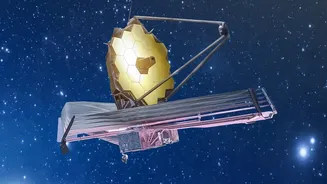
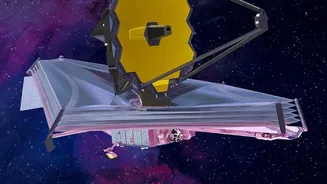
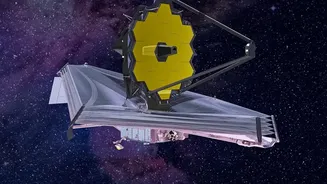
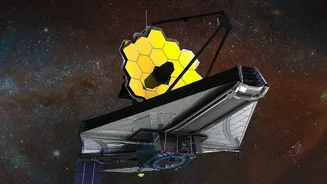
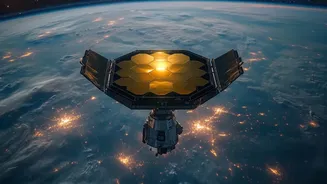
The research team wasn’t looking for a new planet. Their original goal was to use the James Webb Space Telescope's Near-Infrared Spectrograph (NIRSpec) to study the atmosphere of the already-known planet, Beta Pictoris b. But as they analyzed the data, something else appeared. The “surprise signal” wasn’t a bright dot of light, which is how most directly-imaged planets are found. Instead, it was a distinct chemical fingerprint—the tell-tale sign of carbon monoxide, water vapor, and methane in a place they didn’t expect to see it. This atmospheric signature was the clue that a third, hidden object was lurking in the system. As lead author Aidan Gibbs noted, "We weren't looking for a new planet. We were trying to understand one we already knew existed."
Introducing Beta Pictoris d
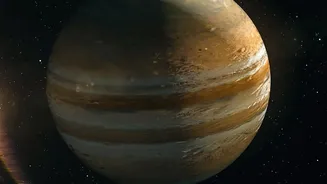
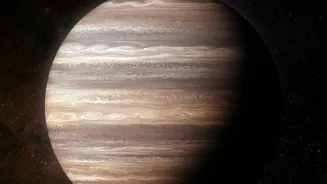
The newfound world, now named Beta Pictoris d, is a gas giant with at least twice the mass of Jupiter. Even so, it appears to be the smallest of the three known planets in the system. Unlike its siblings, which were discovered through direct imaging, Beta Pictoris d was revealed by its atmospheric composition, a testament to the Webb telescope's incredible sensitivity. The planet is on a wide orbit, further out from its star than the other two planets, comparable to where Neptune sits in our own solar system. Its discovery makes Beta Pictoris only the second planetary system known to have at least three directly imaged planets, offering a rare opportunity to study multiple worlds that formed in the same environment.
A New Way to Find Planets
This discovery is more than just adding another planet to the census; it pioneers a powerful new method for finding exoplanets. Traditionally, finding planets via direct imaging is difficult, especially in dusty, cluttered systems like Beta Pictoris, where the glare from the star and its debris disk can easily hide a planet's light. By searching for the molecular fingerprints of a planet's atmosphere instead of just a point of light, astronomers can now cut through the noise. The Webb telescope's ability to perform this high-resolution spectroscopy—splitting light into its component wavelengths to analyze its chemistry—was key. This technique could prove invaluable for discovering other elusive planets hidden in the bright chaos of young, planet-forming disks around other stars.
Why This Discovery Matters
Finding Beta Pictoris d helps us understand the context of our own solar system. Every new exoplanet discovery helps answer the question of whether our home system is common or a cosmic rarity. The Beta Pictoris system, with its hierarchy of outer giant planets, is like seeing a bulked-up version of what our own solar system may have looked like in its infancy. Studying the orbits and interactions of these three giant planets can provide crucial insights into how planetary systems stabilize and whether they can host smaller, rocky, and potentially habitable worlds closer to the star. It’s another key piece in the grand puzzle of how we got here and whether life might exist elsewhere in the universe.