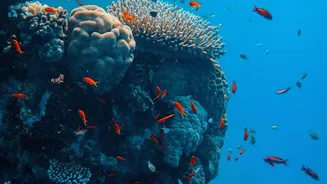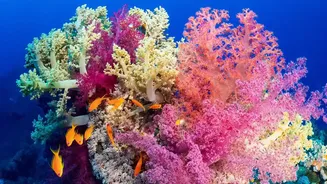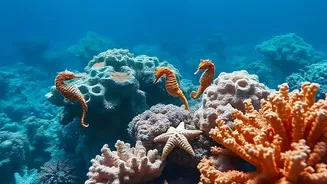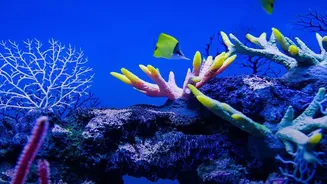





Our planet’s vibrant coral reefs are in crisis, facing widespread bleaching events that leave them ghostly white and struggling to survive. But a stunning new laboratory discovery offers a glimmer of hope from an unexpected source: the corals themselves.
A Healing Touch for Corals
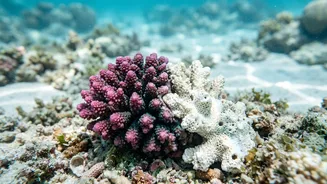
In what sounds like a scene from a science fiction story, researchers at Stanford University have found that a bleached, dying coral can be rescued by simple physical contact with a healthy neighbour. In a controlled lab setting, they demonstrated the fastest documented recovery from coral bleaching ever recorded. A bleached fragment of coral, on the verge of death, was able to regain its full health and vibrant colour in as little as seven weeks after being placed in direct contact with a healthy fragment. This breakthrough came from an accidental observation in 2025, when a marine biologist noticed a bleached coral in a lab tank recovering where a healthy one had fallen against it. This prompted a dedicated experiment with a stark and hopeful outcome: every bleached coral that touched a healthy one recovered, while those kept just millimetres apart did not survive.
How Does Coral-to-Coral Rescue Work?
The secret lies in the very biology of the coral. Corals get their famous colours and most of their food from microscopic algae called zooxanthellae that live inside their tissues. When water temperatures rise, corals get stressed and expel these algae, causing them to turn white, or 'bleach'. While not immediately fatal, this leaves them starving and vulnerable. The Stanford study found that when two genetically identical corals touch, their tissues can fuse together. This creates a microscopic 'tissue bridge' that acts like a highway, allowing the healthy coral to send a flood of essential algae and nutrients directly into its bleached neighbour. Researchers were amazed by the speed of this process; the algae didn't just trickle in, they flooded the bleached tissue, beginning to divide and multiply at a rate nearly ten times faster than seen during natural recovery in the wild.
The Experiment and Its Surprising Speed
The experiment, led by PhD student Danny Collins, was elegant in its simplicity. The team took fragments from a single 'mother' coral colony, ensuring they were all genetically identical. They bleached some fragments and then created ten pairs, each with one bleached and one healthy piece. Five pairs were placed in direct contact, while the other five were separated by a small gap. The results were unambiguous. The five touching pairs all made a full recovery. The five separated pairs did not. Even more remarkable was the discovery that the contact didn't need to be permanent. The team found that just one week of contact was enough to transfer sufficient algae for the bleached coral to continue recovering entirely on its own. In some cases, as little as three to five days was enough to jumpstart the process.
From the Lab to India's Reefs?
While this discovery is incredibly exciting, the researchers are quick to add important caveats. The biggest limitation is that the process of tissue fusion only works between genetically identical corals—clones from the same parent colony. When researchers tried pairing corals from different genetic backgrounds, the corals treated each other as intruders and fought instead of cooperating. This presents a major challenge for applying this in the wild, where genetic diversity is vast. It's not a silver bullet that can be immediately deployed to save India's precious reefs in places like the Andaman Islands or the Gulf of Mannar. Scaling this technique from tiny lab fragments to entire reef ecosystems is a monumental hurdle that scientists are just beginning to think about.
A New Piece of the Conservation Puzzle
Despite its limitations, this finding is a significant step forward. It fundamentally changes how scientists view bleached corals—not as a lost cause, but as organisms with a 'remarkable potential to recover'. Previous conservation efforts have focused on preventing bleaching by providing shade or breeding more heat-resistant corals. This study introduces a new possibility: post-bleaching intervention. It provides a new tool for restoration efforts, perhaps in 'coral nurseries' where genetically identical corals could be used to 'inoculate' bleached fragments before they are returned to the reef. The discovery opens up a completely new line of research focused on helping corals help themselves. It underscores the resilience of nature and provides a crucial dose of hope, reminding us that there is still so much to learn in the urgent race to save our planet's reefs.