






A Flight of Firsts and a Fiery End
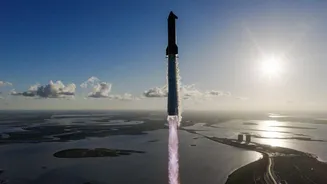
On Monday, September 28, the world's most powerful rocket lifted off from Starbase, Texas, embarking on its most ambitious test yet. The primary goals for Flight 14 were monumental: achieve orbit for the first time, deploy a batch of operational Starlink
satellites, and survive a high-speed reentry before splashing down. The flight successfully reached orbit and deployed 26 next-generation Starlink satellites, a crucial first for the program. However, the mission did not go entirely to plan. During ascent, one of the Starship's upper-stage Raptor engines shut down prematurely. Despite this, mission controllers made the bold call to proceed to orbit. Originally planned to last nearly 10 hours and circle the globe six times, the mission was cut short. After just under three hours, SpaceX opted for an early deorbit, bringing the vehicle down for a controlled splashdown in the Pacific Ocean north of Hawaii, where it broke apart.
The 'Successful Failure' Philosophy
For any other company, an engine failure and an early end to a mission might be seen as a significant setback. For SpaceX, it is part of the process. The company operates on a philosophy of rapid iterative development: test, fly, fail, fix, and repeat. Each flight, regardless of its outcome, provides invaluable data. Flight 14, despite its anomalies, was overwhelmingly successful by this metric. It proved that Starship could reach orbit even with an engine out, demonstrating crucial redundancy. It also marked the first operational deployment of a payload, a key step toward commercial viability. The Super Heavy booster also performed a controlled splashdown in the Gulf of Mexico, another step toward the ultimate goal of full reusability. While the engine failure will be closely investigated, the mission achieved most of its primary objectives, advancing the program far more than a scrubbed launch on the ground would have.
The Raptor Engine Challenge
At the heart of the drama is the Raptor engine, a highly advanced and complex piece of engineering. Starship's upper stage is powered by six of these engines, while the Super Heavy booster uses a staggering 33. These methane-fueled engines are the key to Starship's power and reusability, but they have also been a source of recurring challenges in previous test flights. Engine issues, including failures to ignite, have affected prior missions like Flight 12. The failure on Flight 14 is therefore not an isolated incident but part of the ongoing effort to master the operation of dozens of these powerful engines simultaneously. Engineers will now analyze the data to determine if the shutdown points to a one-off component failure or a broader design issue that needs to be addressed across the fleet.
Why This Test Matters for the Moon and Mars
Starship is more than just another rocket; it is the cornerstone of Elon Musk's long-term vision of making humanity a multi-planetary species. In the nearer term, it has enormous commercial and scientific implications. A version of Starship has been selected by NASA to be the lunar lander for its Artemis program, which aims to return astronauts to the Moon by 2028. Delays in the Starship program could therefore impact NASA's ambitious timeline. The successful satellite deployment also demonstrates Starship's potential to revolutionize the launch industry, eventually carrying up to 100 tons of cargo to orbit. This capability is essential for building out SpaceX's own Starlink internet constellation with larger, more capable V3 satellites that cannot fit in its workhorse Falcon 9 rocket. Every test flight, even one that ends in a splashdown, is a critical step toward these future goals.