







Every December, the hills of Nagaland come alive with the Hornbill Festival. But why is it inextricably linked to one specific place: the Naga Heritage Village at Kisama? The answer lies in a blend of purpose-built design and profound cultural symbolism.
A Permanent Home for a 'Festival of Festivals'
Since its inception in the year 2000, the Hornbill Festival has grown into a globally recognised event, famously dubbed the 'Festival of Festivals'. Its mission is to celebrate and preserve the rich, diverse cultures of the Naga tribes while promoting inter-tribal harmony. To achieve this, a permanent venue was needed. The Naga Heritage Village at Kisama, located about 12 kilometres from the state capital Kohima, was established as that home. Unlike a regular village that grows organically, Kisama was purpose-built by the Nagaland government specifically to host this grand cultural congregation. The name itself, 'Kisama', is a portmanteau of the names of two nearby villages, Kigwema and Phesama, who donated the land, symbolizing a collective Naga identity.
A Microcosm of Naga Culture
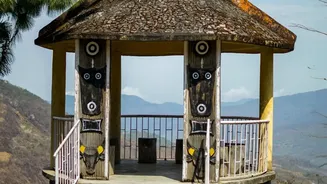
The single most important reason for Kisama being the venue is its unique design. The village is a living, open-air museum designed to represent all of Nagaland in one accessible location. The grounds feature dedicated 'Morungs', or traditional youth dormitories, for each of the state's major tribes. These are not just generic huts; each Morung is an authentic architectural representation of its tribe's specific style, complete with distinct carvings, decorations, and motifs. This allows visitors to walk from the Ao Morung to the Konyak Morung, the Sumi Morung to the Chang Morung, experiencing the architectural and cultural diversity of the Naga people side-by-side in a way that would otherwise require travelling across the entire state. During the festival, each Morung becomes a hub of activity, where tribes showcase their unique songs, dances, food, and customs.
Logistics, Landscape, and Accessibility
Beyond the cultural symbolism, Kisama offers significant practical advantages. Its location on a sprawling hillside provides a natural amphitheatre, ideal for the main performance arena where large-scale cultural shows are held. There is ample space for the hundreds of stalls selling traditional crafts, local cuisine, and contemporary art, as well as dedicated areas for parking and visitor amenities. Being just a short drive from Kohima, it is easily accessible for the thousands of domestic and international tourists who attend the festival annually. This proximity to the capital ensures that visitors have access to a wider range of accommodation and transport options. The village remains open year-round as a heritage complex, but it truly comes to life for those ten days in December, transforming into the cultural epicentre of Nagaland.
Fostering Unity and Economic Growth
The festival was founded by the Nagaland government to encourage interaction and understanding between the different Naga tribes. By providing a common ground at Kisama where every tribe has its own respected space, the venue itself fosters a spirit of 'unity in diversity'. It creates an environment where traditions are not just performed for an audience but are also shared between communities, helping to keep them alive for younger generations. Furthermore, the concentration of the festival in one wellmanaged location has been a cornerstone of its success in boosting Nagaland's tourism economy. It creates a vibrant marketplace that generates significant income for artisans, performers, cooks, and local entrepreneurs, making the preservation of culture an economically sustainable activity.