




What 'Winding Down' Really Means
When astronomers say a galaxy is 'winding down', they aren't talking about its majestic spiral slowing its spin. Instead, they are referring to its rate of star formation—the process of turning vast clouds of gas and dust into new, shining stars. A recent
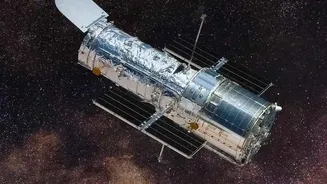
study using a trove of data from the Hubble Space Telescope found that Andromeda's star-making has been in a steady decline for the last 500 million years. The rate of decline has become even more pronounced in the last 40 million years. About 500 million years ago, Andromeda was creating stars at a rate of roughly one solar mass per year. Today, that has plummeted to just one-fifth of a solar mass annually, marking a significant transition in its life cycle.
Galactic Archaeology with Hubble
So how can a telescope with a few decades of service create a 500-million-year record? The answer lies in a field called 'galactic archaeology'. Astronomers can't watch a galaxy evolve over eons, but they can study its 'fossil record'—the billions of stars it contains. By meticulously mapping the locations of around 200 million individual stars across two-thirds of Andromeda's disk, scientists could read their history. Massive stars burn hot and blue but have very short lives, so their presence signals recent star birth. Smaller, redder stars live for billions of years and represent older populations. By analysing the mix of stellar colours and ages across thousands of different sections of the galaxy, the team effectively created a historical map of its activity.
A Tale of Boom and Bust
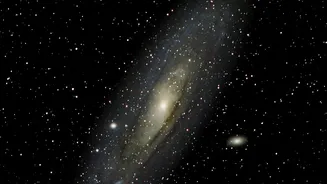
This new research builds on previous findings that showed Andromeda experienced a massive burst of star formation about two billion years ago. That 'starburst' was likely triggered by a close encounter or merger with a smaller galaxy, which compressed its gas clouds and kicked off a stellar baby boom. The current 500-million-year slowdown appears to be the long, quiet aftermath of that dramatic event. Interestingly, the decline isn't uniform. Much of the galaxy's remaining star formation is concentrated in a prominent ring-like structure about 32,000 light-years from Andromeda's core. The fading of activity in this very ring is a key driver of the galaxy's overall decline. Some evidence also suggests that interactions with M32, a compact satellite galaxy, may have created 'dead zones' by disrupting gas clouds.
Our Cosmic Neighbour's Future
Andromeda's quiet phase provides a fascinating contrast to our own Milky Way, which has maintained a more consistent rate of star formation. Studying why two such massive galaxies, living side-by-side in the Local Group, have such different evolutionary paths is crucial for understanding how galaxies in general live and die. This research provides a detailed snapshot of a galaxy transitioning from an active, youthful state to a more quiescent 'middle age'. As our nearest major spiral galaxy, located 2.5 million light-years away, Andromeda is the perfect laboratory for these studies. The insights gained from its past help refine models for how all galaxies, including our own, evolve over cosmic time.
A Glimpse of Our Own Destiny?
This story has a very long-term local angle: the Milky Way and Andromeda are on a collision course. Hurtling toward each other at over 400,000 kilometres per hour, the two galaxies are predicted to merge in about 4 to 5 billion years. While the vast distances between stars mean direct collisions will be rare, the gravitational chaos of the merger will throw stars into new orbits and compress huge amounts of interstellar gas. This will likely trigger a colossal starburst event, temporarily reversing Andromeda's decline and lighting up the newly formed giant galaxy, sometimes nicknamed 'Milkomeda'. What we are seeing now in Andromeda is simply one chapter in the life of a galaxy—a quiet period before the next dramatic, creative burst in the distant future.