



Echoes of a Violent Past
The solar system's early history was a shooting gallery, with planet-sized bodies and smaller rocks constantly crashing into each other. While we see the craters left by these impacts on the Moon and Mars, the effects on the asteroids themselves have
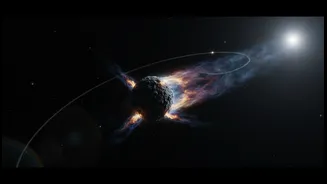
been harder to decipher. Scientists have long understood that collisions are the main force controlling how asteroids rotate. A direct hit can send an asteroid spinning faster, while a glancing blow might cause it to tumble chaotically through space. New studies are revealing that the signatures of these ancient, formative impacts can persist for billions of years, overriding other forces that were thought to dominate over time.
The Cosmic Tug-of-War
An asteroid's spin is not a simple matter. It's the result of a constant cosmic tug-of-war. On one side, you have collisions, which can knock an asteroid into an unstable, tumbling motion. On the other side are two stabilizing forces: internal friction, which works to smooth out a chaotic tumble, and a more subtle force known as the YORP effect. The YORP effect is a torque created by sunlight; as an asteroid's surface heats up and then cools, it emits radiation that gives it a tiny, continuous push. For a long time, astronomers believed that over millions of years, the gentle but persistent YORP effect would eventually erase the memory of ancient impacts, gradually changing an asteroid's spin to a more stable state.
When Impacts Have the Last Word
Recent research, however, challenges this view. By analyzing vast amounts of data from missions like the European Space Agency's Gaia satellite, scientists have found that the rotational properties of many asteroids don't match what the YORP effect alone would predict. The data shows a distinct split between fast, stable spinners and a large population of slow, tumbling asteroids. Models suggest that catastrophic collisions—those powerful enough to eject nearly half of an asteroid's mass—set a baseline rotation rate that is surprisingly resistant to change. The impact is so profound that its influence can dominate, locking the asteroid into a specific rotational state that the weaker YORP effect struggles to alter, especially for slowly spinning or tumbling bodies.
A New Tool for Reading History
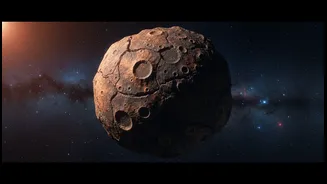
This discovery provides astronomers with a powerful new tool. By observing an asteroid's current rotation—whether it's spinning smoothly or tumbling chaotically, and at what speed—they can infer details about its violent history. A slow, tumbling asteroid, for instance, might be the result of a smaller, more recent collision that didn't have enough energy to be dampened by internal friction. Conversely, the average spin rate observed across many asteroids closely matches the rate predicted for the remnants of massive, catastrophic impacts billions of years ago. This suggests that what we see today is a direct and lasting consequence of the solar system's formation, allowing scientists to effectively read an asteroid's past in its present-day motion. The data can even offer clues about an asteroid's internal structure, distinguishing solid, monolithic rocks from loosely-held-together 'rubble piles'.
Why This Cosmic Detective Work Matters
Understanding how asteroids behave is crucial for several reasons. Firstly, it deepens our knowledge of how the solar system formed and evolved. These space rocks are leftover building blocks from planet formation, and their histories tell us about the conditions of that primordial era. Secondly, it has direct implications for planetary defense. If humanity ever needs to deflect an asteroid on a collision course with Earth, we must understand its composition and rotational dynamics. Knowing whether an asteroid is a solid rock or a spinning pile of gravel, and how it will react to a push, is critical for designing an effective mission. This new understanding of impact-driven rotation adds a vital piece to that complex puzzle, helping us better prepare for potential threats from our cosmic neighbors.