




Humanity's first successful planetary defense test, the DART mission, proved we could nudge an asteroid. Now, scientists are taking the next leap: practicing for the real thing in the digital world with unprecedented speed and realism.
From Physical Test to Digital Twin
In 2022, NASA’s
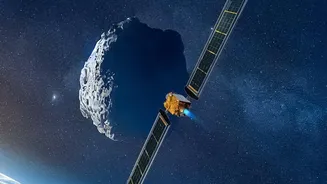
Double Asteroid Redirection Test (DART) made history by deliberately crashing a spacecraft into the small asteroid Dimorphos. The goal was to see if a 'kinetic impact' could alter an asteroid's path, a crucial proof-of-concept for defending Earth. The mission was a resounding success, shortening Dimorphos's orbit around its larger companion, Didymos, by 33 minutes. This physical test was a monumental achievement, but it was just one scenario with one type of asteroid. To be truly prepared for a potential threat, scientists need to be able to model countless possibilities, and that’s where the next phase of planetary defense is unfolding: 'in silico', or within a computer.
Why A Perfect Sphere Isn't Enough
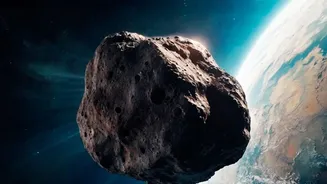
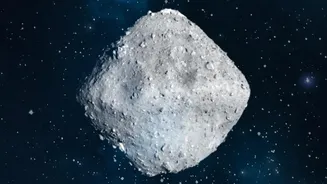
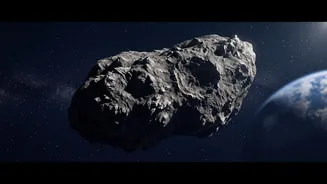
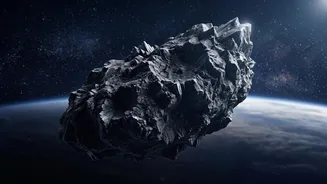
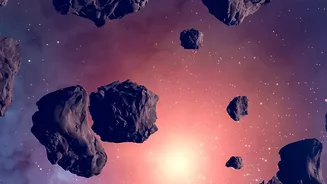
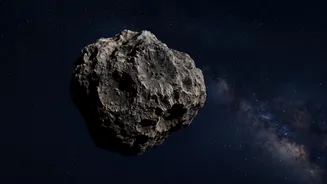
A major challenge in simulating asteroid deflection has been their shape. For years, models simplified asteroids as smooth, spherical objects to make the complex calculations manageable. The problem is, real asteroids are anything but perfect spheres. They are irregular, lumpy, and covered in ridges, boulders, and depressions, with shapes resembling anything from a peanut to a spinning top. This irregular topography dramatically changes how an asteroid reacts to an impact or a blast of energy. Hitting a lumpy, tumbling rock is far more unpredictable than hitting a marble. The angle of impact, the surface features at that point, and the asteroid's rotation can all lead to vastly different outcomes, making simplistic models unreliable for real-world mission planning.
A Breakthrough in Speed and Realism
This is the problem a new generation of computer models, developed by researchers at Sandia National Laboratories, aims to solve. Their latest work, published in the science journal Icarus, introduces a new algorithm that is a game-changer. It allows scientists to create detailed, three-dimensional models of asteroids based on data from actual spacecraft flybys, capturing their true, irregular shapes. More importantly, these new simulations are incredibly fast—over 1,600 times faster than older methods. This speed is critical because it moves these complex calculations from the realm of the theoretical to the practical. What once took too much computing power to be feasible can now be done efficiently, allowing for robust and rapid analysis.
Simulating Countless Scenarios
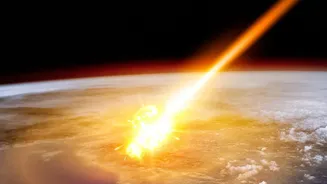
The new models simulate how a 'stand-off' explosion—a nuclear device detonated near the asteroid—would affect the body. The intense burst of X-rays from the blast vaporizes surface material, creating a powerful push that nudges the asteroid off its course. By combining realistic shapes with high-fidelity physics, the simulations revealed something startling: where you aim matters immensely. For the same asteroid, targeting one side versus another could change the effectiveness of the deflection by nearly a factor of five. In another simulation, the change in the asteroid's rotation differed by a factor of 17 depending on the blast direction. With the ability to run thousands of scenarios quickly, scientists can now test different blast yields, distances, and angles to find the most effective 'sweet spot' for any given asteroid shape, a critical step in planning a potential real-life defense mission.
The Future of Planetary Defense
While kinetic impactors like DART are the preferred method for deflecting asteroids discovered with plenty of warning, the new models address a more urgent scenario: a late-time interception of a newly found threat where more energy is needed. These faster, more realistic simulations provide a crucial planning tool. Mission planners could, in principle, upload the known shape of a threatening asteroid and calculate the optimal way to steer it away from Earth. Of course, limitations remain. The models need accurate shape data, which may be hard to get in a hurry, and they can't yet reliably predict if an asteroid will completely break apart. However, this represents a significant leap forward, moving us from guesswork to data-driven strategy. It's an upgrade to our planetary defense toolkit that makes our planet a little bit safer.