



Antarctica's Unstable Giant
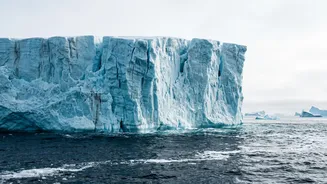
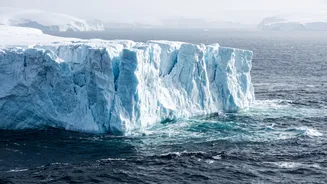
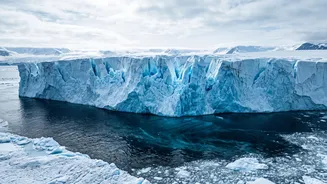
Thwaites Glacier, a colossal river of ice in West Antarctica roughly the size of Great Britain, is one of the most unstable and significant glaciers on the planet. It already contributes around 4% of annual global sea-level rise. Scientists have long
been concerned about its stability because it sits on a bedrock that slopes downwards inland. This reverse slope means that as warmer ocean water melts the glacier's edge, the glacier retreats into deeper water, exposing more of its underbelly to the melt. Because of its sheer size and the fact that it acts as a natural dam holding back the rest of the West Antarctic Ice Sheet, its complete collapse could eventually raise global sea levels by more than two feet, and potentially up to 10 feet if it brings neighbouring glaciers with it. This potential for catastrophe is what earned it the ominous moniker, the 'Doomsday Glacier'.
A Hidden Threat Revealed
For years, computer models of glaciers treated the 'grounding line'—the point where the ice leaves the seabed and begins to float—as a sharp, fixed boundary. However, recent satellite data revealed a much more complex and worrying reality. As tides rise and fall, warm, salty ocean water is not just nibbling at the edge; it's being actively pumped for kilometres under the part of the glacier that should be firmly on the ground. A new model developed by researchers at the University of California, Irvine, and NASA’s Jet Propulsion Laboratory incorporates this 'grounding zone' for the first time. By simulating this hidden seawater intrusion, the model was able to reproduce the glacier's observed melting, thinning, and retreat over the past three decades with far greater accuracy than previous models.
How Water Accelerates Collapse
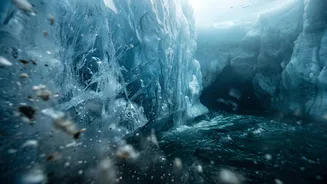
The presence of this warm water deep beneath the ice is a game-changer. This process, sometimes called 'tidal pumping', allows the ocean to attack the glacier from below, causing what scientists call 'vigorous melting'. This lubricates the base of the glacier and accelerates its slide toward the sea. The new model suggests that this process has been significantly underestimated. When the researchers ran their improved model forward, they found that Thwaites could contribute up to 30 millimetres to global sea-level rise by 2100. This is roughly double the average projection from previous multi-model comparisons, even without factoring in future climate warming. The model also highlights the risk of the glacier detaching from a key underwater ridge that is currently helping to hold it back, a development that could happen as early as the late 2030s.
Why Antarctica's Fate Matters to India
A melting glacier thousands of kilometres away might seem like a distant problem, but its consequences are dire for India. With a coastline spanning over 7,500 kilometres, India is highly vulnerable to sea-level rise. Even a few centimetres can have a dramatic impact, leading to increased coastal flooding, erosion, and saltwater intrusion into freshwater sources, affecting agriculture and drinking water for millions. Major coastal cities like Mumbai, Chennai, Kolkata, and the low-lying Sunderbans delta are on the front lines. The accelerated melt from Thwaites reinforces the urgency of these threats. A 65-centimetre rise from Thwaites' total collapse would be catastrophic, displacing populations and devastating infrastructure. The findings from the new model are not just an academic exercise; they are a critical warning for India to bolster its coastal defences, protect vulnerable ecosystems like mangroves, and prepare for a future where the sea is significantly higher.