
A New Eye on the Sun
The source of these groundbreaking images is the National Science Foundation's Daniel K. Inouye Solar Telescope (DKIST) on Maui, Hawaii. As the world's most powerful solar telescope, its massive four-meter primary mirror collects more sunlight than any
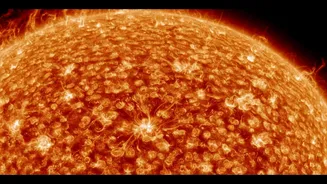
other, allowing it to resolve features on the sun's surface as small as 20 kilometers across. While NASA is a key partner in solar research, these particular images come from the NSF-operated facility, representing a collaborative effort to push the boundaries of heliophysics. The images were so detailed that scientists initially took them to test and fine-tune the telescope's limits before realizing they had captured the sun's outer shell, the photosphere, at a higher resolution than ever before.
Seeing the Swirls
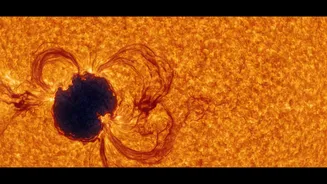
So, what do these ultra-sharp images actually show? They reveal a complex and dynamic landscape dominated by granular structures and, for the first time, tiny, whirlpool-like patterns. These swirls are the visual signature of a long-theorized phenomenon called the Kelvin-Helmholtz instability (KHI). This effect occurs when fluids or plasmas moving at different speeds slide past each other, creating a shear that grows into vortices. We see this on Earth in wind-swept clouds and ocean waves, but observing it on the sun's surface is a first. These structures, which some have compared to the swirling skies in Van Gogh's "Starry Night," are more than just beautiful; they are crucial clues to the sun's physics.
Solving Solar Mysteries
Observing these instabilities helps scientists tackle two of the biggest questions in solar physics: why the sun's outer atmosphere (the corona) is millions of degrees hotter than its surface, and what drives the explosive events that cause space weather. The KHI vortices are believed to play a role in transporting energy from the surface up into the corona, potentially contributing to its extreme temperature. By studying the fine details at the edges of magnetic areas, scientists can see how magnetic energy builds up, moves, and is eventually released.
Improving How We See
The headline's focus on "Visible-Light Solar Imaging" is key. These images are not just a product of that technique; they are a tool for refining it. By capturing data at the very limit of the telescope's capability, scientists can better understand how to process and interpret high-resolution solar images. They learn how to correct for atmospheric distortion and instrumental artifacts, creating a blueprint for future observations. This meta-level of study—using the data to improve the method of data collection—is crucial. It ensures that the next generation of solar telescopes and imaging techniques will be even more powerful, allowing us to probe the fundamental physics of not just our sun, but other stars as well.
From Solar Physics to Space Weather
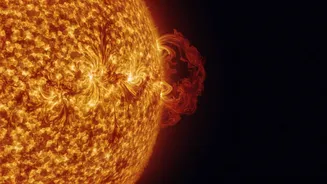
The practical application of this research is a profound improvement in our ability to forecast space weather. Solar flares and coronal mass ejections (CMEs)—massive eruptions of plasma from the sun—are driven by the small-scale magnetic processes that DKIST can now see clearly. These events can send bursts of energy toward Earth, disrupting power grids, damaging satellites, and affecting global communications. By understanding the root causes of this activity with unprecedented detail, scientists can develop more accurate prediction models, giving us more time to prepare for and mitigate the impacts of a solar storm.