


A Groundbreaking Solar Close-Up
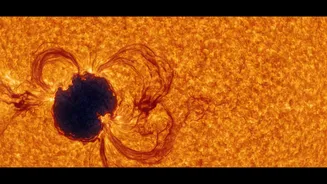
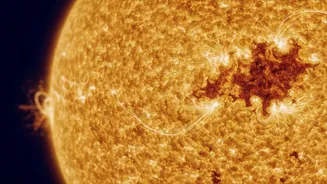
Scientists have released a breathtaking new image of the Sun’s surface, captured by the U.S. National Science Foundation's Daniel K. Inouye Solar Telescope in Hawaii. Released in early August 2026, the photograph shows a section of the Sun's photosphere—its
visible surface—with a level of detail never before achieved. The image highlights the Sun's famously granular texture, which is created by massive cells of hot, rising plasma. But it's the finer details that have astronomers buzzing: small, swirling, whirlpool-like patterns that dance at the edges of these granules. These phenomena, with features as small as a city, provide the first clear, observational proof of a process long predicted by theory but never directly seen.
Decoding the City-Sized Swirls
So, what are these mesmerising patterns? They are the signature of a physical process called the Kelvin-Helmholtz instability (KHI). This occurs when two fluids, or in this case plasmas, flow past each other at different speeds, creating a shear that grows into swirling vortices. You can see a similar effect on Earth in cloud formations or where wind blows over water. On the Sun, this instability happens where superheated plasma moving at high speeds interacts with slower, cooler plasma along magnetic boundaries. The individual convection cells, known as granules, are already enormous—typically around 1,500 kilometres in diameter, larger than many countries. The newly spotted KHI swirls and streaks at their edges, some just tens of kilometres across, offer a new window into the micro-dynamics of our star's incredibly violent surface.
The Technology Behind the Vision
Capturing such an image is a monumental technological feat. The Daniel K. Inouye Solar Telescope is the most powerful solar telescope in the world, boasting a massive 4-meter primary mirror. This allows it to collect seven times more sunlight than any other solar telescope, providing unmatched clarity. Located atop the Haleakalā volcano in Maui, its advanced optics can resolve features on the Sun's surface as small as 20 kilometres. To put that into perspective, it's like being able to spot an object the size of a small car from a hundred kilometres away. This power has allowed scientists to finally confirm the existence of KHI on the Sun, a phenomenon that was previously hidden from view by the limitations of older instruments.
Why It Matters for Us on Earth
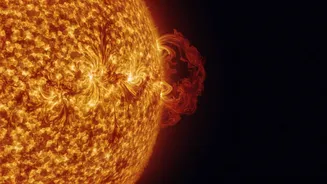
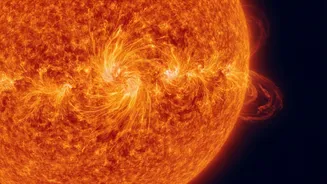
While these swirls are happening 150 million kilometres away, understanding them has profound implications for life on Earth. These small-scale dynamics are believed to be a key part of the engine that transfers energy into the Sun's outer atmosphere, the corona, heating it to millions of degrees—far hotter than the surface below. This process also twists and braids the Sun's magnetic field lines, building up energy that is eventually released in the form of solar flares and coronal mass ejections (CMEs). These powerful solar eruptions drive space weather, which can disrupt our power grids, damage satellites, and interfere with GPS and communication systems. By studying these fundamental processes in unprecedented detail, scientists hope to improve their models for predicting space weather, giving us more time to prepare for potentially damaging solar storms.