



Meet NASA's New Cosmic Surveyor
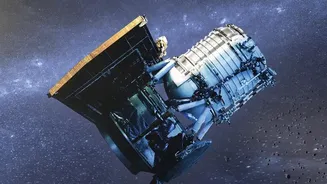
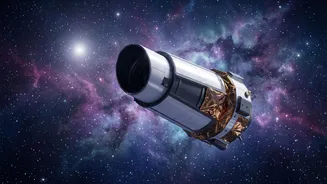
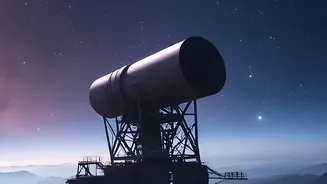
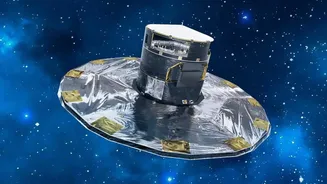
The Nancy Grace Roman Space Telescope is NASA's next flagship mission in astrophysics, named after the agency's first chief of astronomy. Often called the 'mother of Hubble', Nancy Grace Roman was instrumental in making large-scale space telescopes a reality.
Following in that legacy, the Roman telescope is designed not just to see farther, but to see wider than ever before. Launched in late August 2026, it is now journeying to a stable orbit about 1.5 million kilometers from Earth. Its primary goals are ambitious: to unravel the secrets of dark energy and dark matter, discover thousands of new exoplanets, and provide unprecedented views of our galaxy and beyond.
A Panoramic View of the Universe
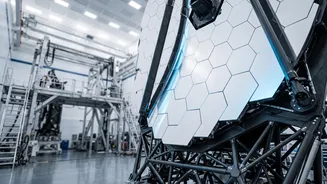
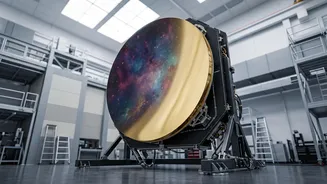
While telescopes like Hubble and the James Webb Space Telescope (JWST) act like zoom lenses, providing incredibly detailed views of small patches of sky, Roman is built to be a wide-angle lens. It features a 2.4-meter mirror, the same size as Hubble's, but its Wide Field Instrument (WFI) gives it a field of view 100 times larger. This means in a single snapshot, Roman can capture an area of the sky that would take Hubble hundreds of pictures to cover. This survey capability is its superpower. Over its five-year primary mission, Roman is expected to observe 50 times the amount of sky that Hubble has in over 30 years, mapping the positions and shapes of billions of galaxies.
Simulating a Universe of Millions of Galaxies
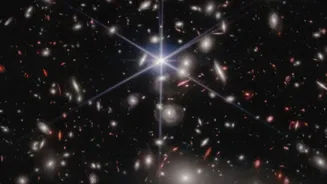
The recent buzz around Roman highlighting 'millions' of objects stems from a sophisticated new computer simulation, not an actual image from the now-launched telescope. To prepare for the flood of data Roman will produce, scientists created a synthetic universe to test their strategies. One such simulation, showcasing a tiny fraction of what Roman will survey, contains a staggering 33 million galaxies and 200,000 foreground stars. Another simulated deep-field view showed how Roman could expand on Hubble's famous Ultra Deep Field, capturing millions of galaxies in an area 300 times larger. These simulations are crucial for helping astronomers plan observations and refine the methods needed to mine the mission's vast datasets.
Tackling The Biggest Cosmic Questions
With its immense survey power, Roman is uniquely equipped to tackle some of the biggest mysteries in cosmology. One of its key objectives is to study dark energy, the mysterious force causing the universe's expansion to accelerate. By mapping the distribution of galaxies across cosmic time, astronomers hope to understand if dark energy's influence has changed over billions of years. The telescope will also hunt for thousands of exoplanets using a technique called gravitational microlensing, which can detect planets far from their star, including free-floating 'rogue' planets that don't orbit a star at all. Its second instrument, a technology-demonstrating Coronagraph, will practice blocking starlight to directly image Jupiter-sized planets, paving the way for future missions.
A New Era of Collaborative Discovery
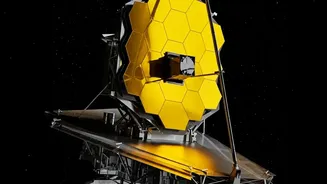
Roman is not a replacement for Hubble or Webb, but a powerful new partner in a cosmic fleet. Its wide-angle discoveries will serve as a cosmic roadmap, identifying fascinating targets for its sibling telescopes to investigate in greater detail. Roman might spot thousands of intriguing galaxies or planetary systems, and Webb can then use its powerful infrared vision to zoom in and analyze their chemical compositions and atmospheres. This synergy will dramatically accelerate the pace of discovery. Having successfully launched on August 30, 2026, the telescope is now undergoing commissioning, with its first science operations expected to begin in early 2027.