




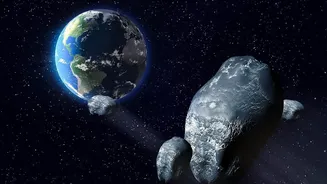

Humanity's first successful planetary defense test, the DART mission, proved we could nudge an asteroid off course. But new research reveals a critical wrinkle: when it comes to saving the planet, it's not just about hitting the asteroid, but where.
A Milestone in Planetary Defense
In
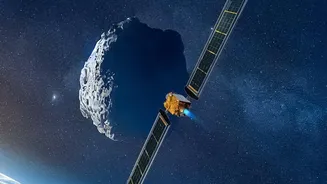
2022, NASA’s Double Asteroid Redirection Test (DART) made history. A refrigerator-sized spacecraft intentionally slammed into Dimorphos, a small asteroid moonlet, at a blistering speed. The goal was simple: to see if a 'kinetic impactor' could alter an asteroid's path. The mission was a resounding success, changing Dimorphos's orbit around its parent asteroid by 33 minutes—far more than the minimum benchmark for success. This proved the fundamental concept of asteroid deflection is viable. The force of the impact was amplified by the recoil from the rock and dust blasted into space, an effect that scientists are now studying with the follow-up Hera mission. DART provided a crucial real-world baseline, moving planetary defense from theory to a tested reality.
Beyond Brute Force: A New Model
While kinetic impactors are a leading strategy, scientists are exploring other methods for different scenarios, especially for larger threats or when there's less warning time. One powerful but complex option involves detonating a nuclear device near an asteroid. The goal isn't to shatter it, which could create multiple hazards, but to use the intense X-ray radiation from the blast to vaporize a layer of the asteroid's surface. This vaporization acts like a powerful thruster, pushing the asteroid onto a new, safer trajectory. Recent research from Sandia National Laboratories has introduced a powerful new computer model to simulate this exact scenario. Published in the journal Icarus, the study was led by physicist Nathan Moore and provides the most detailed look at this process to date.
Why Aim Is Everything
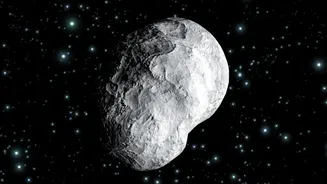
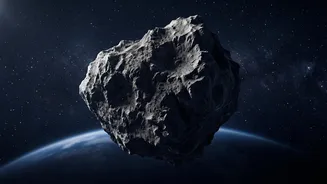
Previous simulations often had to simplify the problem by modeling asteroids as perfect spheres. However, most asteroids are lumpy, potato-shaped, and irregular. The Sandia Labs team developed a new algorithm over 1,600 times faster than older versions, allowing them to use realistic 3D shapes of known asteroids like Bennu and Golevka while performing high-fidelity physics calculations. The results were startling. The simulations showed that the effectiveness of the deflection depended enormously on which part of the irregular asteroid was targeted. For one simulated asteroid, hitting it on one side produced a deflection velocity nearly five times greater than hitting it on another side. The impact on the asteroid's spin could vary by as much as a factor of 17. As Moore noted, they expected aim to matter, but were surprised by how much.
The Challenge of Irregular Surfaces
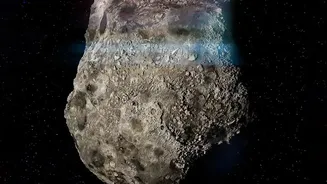
An asteroid's uneven surface, with its random collection of slopes, ridges, and valleys, means that an energy blast is not distributed evenly. Hitting a relatively flat, solid face might provide a clean and efficient push. In contrast, hitting a concave area or a loosely consolidated slope could result in the vaporized material pushing against itself, muffling the overall effect and wasting a significant amount of the deflection energy. This highlights a critical challenge for any future planetary defense mission: we need to know what we are aiming for. An asteroid isn't just a dot in a telescope; it’s a physical object with a unique topography. This new model confirms that without detailed, advance reconnaissance to map an asteroid's shape and composition, a deflection attempt could be far less effective than planned, potentially making the difference between a near-miss and a catastrophe.