






The Junkyard Above Our Heads
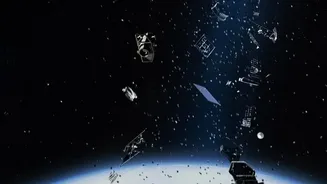
Space debris, or 'space junk', refers to any piece of machinery or debris left by humans in space. This includes everything from entire non-functional satellites and spent rocket stages to tiny fragments from collisions. According to the European Space Agency,
there are an estimated 36,500 objects larger than 10 cm orbiting our planet. These objects travel at incredible speeds, up to 28,000 kilometres per hour. At that velocity, even a small fleck of paint can cause catastrophic damage to an operational satellite or a crewed spacecraft. The growing concern is a scenario known as the Kessler Syndrome, where the density of objects in Low Earth Orbit (LEO) becomes so high that collisions between objects cause a cascade, creating even more debris and making LEO unusable for future generations.
Meet the Cleanup Crew
A new industry is emerging to tackle this problem. Companies like Japan's Astroscale and Switzerland's ClearSpace are pioneering 'on-orbit services'. Astroscale has launched missions to demonstrate technologies for docking with and inspecting debris, while ClearSpace has a contract with the European Space Agency for the first-ever mission to actively remove a piece of debris, scheduled for 2026. Their technologies sound like science fiction: robotic arms, powerful magnets, harpoons, and giant nets designed to capture non-cooperative targets tumbling through space. Large aerospace and defense firms such as Northrop Grumman are also key players, leveraging their expertise in satellite servicing to develop solutions. These companies are betting that as LEO becomes more congested, their services will shift from experimental to essential.
The Business of Debris Removal
The primary drivers turning space cleanup into a viable market are regulation and commercial demand. The rapid deployment of 'mega-constellations' by companies like SpaceX (Starlink) and Amazon (Project Kuiper) has dramatically increased the number of satellites in LEO. This congestion creates a direct business case for protecting these valuable assets. Satellite operators are the main customers, driven by the need to safeguard their multi-billion dollar investments and ensure the long-term sustainability of their services. As insurance providers begin to price in the risk of orbital collisions, and with thousands of new satellites being launched annually, the demand for active debris removal and end-of-life deorbiting services is accelerating.
The Rules of the Orbital Road
For the market to truly take off, clear and enforceable regulations are essential. Historically, international guidelines have been voluntary. However, this is changing. In a landmark move, the U.S. Federal Communications Commission (FCC) mandated a new '5-year rule', requiring satellites licensed in the US to be deorbited within five years of completing their mission, a significant reduction from the previous 25-year guideline. This rule creates a direct, compliance-driven demand for deorbiting services. However, significant legal challenges remain. International treaties stipulate that defunct satellites remain the property of their original owner, meaning a cleanup company can't simply remove another nation's debris without permission, creating complex legal and political hurdles to overcome.
The Path to a $9.57 Billion Market
The convergence of these factors—a growing debris problem, advancing technology, commercial self-interest, and strengthening regulations—is what underpins the strong market forecasts. A recent report projects the space debris removal market will grow from around USD 143 million in 2025 to USD 9.57 billion by 2035, a compound annual growth rate of over 40%. This growth reflects the transition of debris removal from a niche technical challenge to a mainstream commercial service. While the costs are still high and many technical and legal hurdles remain, the economic and strategic incentives to ensure a safe orbital environment are now too large to ignore, paving the way for a new generation of space entrepreneurs.