



The Universe’s Impossibly Large Giants
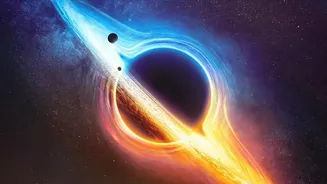
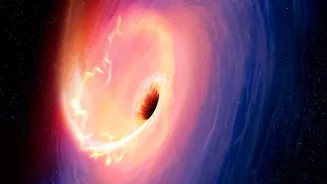
Imagine looking back in time and seeing a toddler who is already the size of a full-grown adult. That’s the kind of baffling problem astronomers face when they look at the early universe. Standard theories suggest that black holes start small—from the collapse
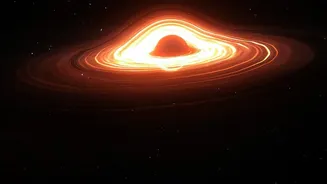
of a single massive star—and grow over billions of years by slowly consuming gas and merging with other black holes. Yet, telescopes have found supermassive black holes, weighing millions or even billions of times more than our sun, that existed when the universe was less than a billion years old. This timeline doesn't seem to add up; it's like they skipped childhood entirely. This puzzle has led scientists to hunt for clues that could explain this accelerated growth, searching for unique objects in the cosmic dawn that might hold the answer.
A Triple-Threat Discovery
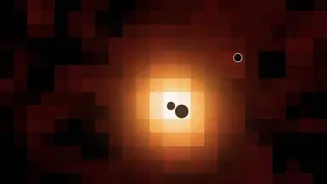
The latest and most compelling clues come from a galaxy known as J0148-4214. Its light has travelled for over 12.5 billion years to reach us, meaning we see it as it was just 1.2 billion years after the Big Bang. Initially, it was thought to host a single active black hole. However, recent, more detailed observations using the James Webb Space Telescope (JWST) have revealed something extraordinary: J0148-4214 contains not one, but three actively feeding supermassive black holes crowded into a single system. This is the first time such a trio has been confirmed in the distant universe, providing a live-action snapshot of the violent processes that shaped the cosmos.
A Picture of Chaotic Growth
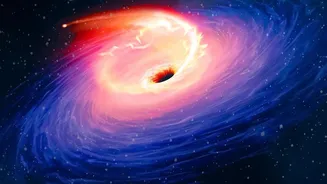
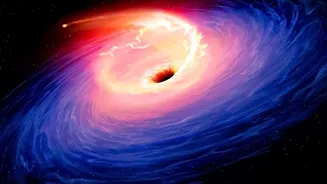
The three black holes in J0148-4214 are a dynamic and varied group. Two of them are located near the galaxy's center, separated by a mere 620 light-years—a tiny distance on a cosmic scale. One of these is a behemoth of about 80 million solar masses, while its close companion is a much smaller 600,000 solar masses. A third black hole, with a mass of around 2 million suns, lurks further out. Crucially, all three are actively accreting, meaning they are furiously pulling in surrounding gas and dust, which causes them to grow. The discovery strongly suggests that one of the main pathways for rapid growth is through galaxy mergers. In the dense early universe, galaxies frequently crashed into each other, bringing their central black holes into close proximity where they could eventually merge and combine their mass.
Mergers as the Missing Ingredient
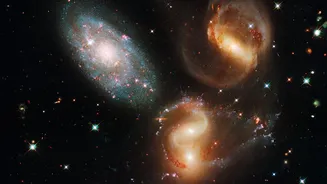
The scene within J0148-4214 provides direct evidence for the merger-driven growth theory. Scientists believe the system is the result of at least two galaxies colliding. The two black holes at the center are on a collision course, expected to merge in a few hundred million years. This process, repeated across the early cosmos, would provide a fast track for creating giant black holes. It helps explain how they bypassed the slow, steady growth from a small 'seed' black hole. Instead of waiting for one black hole to feed for billions of years, the universe brought multiple black holes together in chaotic, merger-filled environments. This finding suggests that interactions and mergers were not just common, but a highly efficient mechanism for building the cosmic titans we see at the center of nearly every large galaxy today, including our own Milky Way.