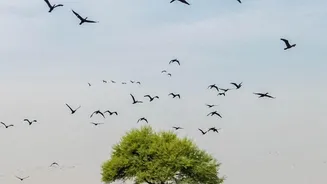








A Sobering Global Assessment
A comprehensive global review published in a leading scientific journal has sounded the alarm for migratory birds worldwide. The study, one of the most thorough to date, synthesises decades of data and concludes that approximately 51% of migratory bird species
are experiencing population declines. This follows a landmark United Nations report which found that nearly half of all migratory species listed for protection are decreasing, and more than one in five are threatened with extinction. The findings point to a widespread and escalating biodiversity crisis that isn’t limited to a few rare species; even once-common birds are now showing significant losses.
The Human Fingerprint on a Perilous Journey
The two greatest threats driving these declines are habitat loss and overexploitation, both overwhelmingly caused by human activity. Migratory birds depend on a connected network of sites for breeding, resting, and wintering. The conversion of wetlands, grasslands, and forests for agriculture and urban expansion breaks these critical links. In India, which sits at the heart of the vital Central Asian Flyway, the degradation of wetlands, pollution from pesticides and plastics, and hazards from infrastructure like power lines pose immense risks. Climate change acts as a threat multiplier, disrupting migration timing, altering habitats, and creating a mismatch between the birds' arrival and the availability of food sources.
India's Critical Role in a Global Flyway
India is a crucial sanctuary for hundreds of species that use the Central Asian Flyway, a migratory route spanning 30 countries from the Arctic to South Asia. Millions of birds, from the iconic Bar-headed Goose that soars over the Himalayas to the Amur Falcon on its long journey to Africa, depend on India's diverse habitats. Wetlands like Chilika Lake and Keoladeo National Park serve as vital 'motels' for these birds, offering food and shelter. Consequently, the health of India's ecosystems has a direct impact on bird populations across a vast swathe of the planet. Recognizing this, the Indian government hosts the Coordinating Unit for the Central Asian Flyway initiative, signalling its commitment to protecting these shared species.
Why Declining Bird Populations Matter
The disappearance of migratory birds is more than just an ecological tragedy; it is an indicator of broader environmental distress and has direct consequences for human well-being. These birds are essential for healthy ecosystems. They act as natural pest controllers, pollinate plants, and disperse seeds, services that are vital for agriculture and forestry. Their decline can disrupt these natural processes, potentially leading to increased pest outbreaks and reduced agricultural yields. As bellwethers of environmental health, a steep drop in bird populations signals that the ecosystems we also depend on for clean water, climate regulation, and resources are themselves under severe strain.
Glimmers of Hope Through Conservation
While the outlook is dire, the situation is not hopeless. Coordinated conservation efforts have proven that recoveries are possible. India has a National Action Plan for the conservation of migratory birds and is a key party to the Convention on Migratory Species (CMS). On the ground, success stories offer powerful examples of change. In Nagaland, community-led initiatives transformed the mass hunting of Amur falcons into a celebrated conservation movement, earning the region the title 'Falcon Capital of the World'. Similarly, in Kashmir, an all-women birding network is working to restore vital wetland habitats, leading to the return of thousands of birds. These efforts highlight that concerted action, from international policy to local community involvement, is the key to securing a future for these global travellers.