







An Unexpected Discovery
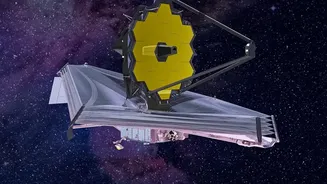
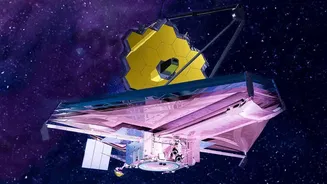
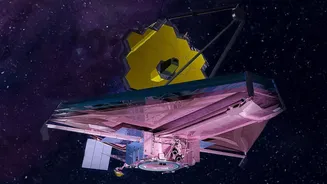
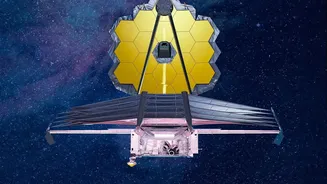
In a remarkable case of scientific serendipity, astronomers using the JWST weren't even looking for a new planet. A team was studying the atmosphere of a known gas giant, Beta Pictoris b, in a star system located 63 light-years away. While analysing the data,
they detected an unexpected signal—a chemical fingerprint that could only belong to another world. This new planet, now named Beta Pictoris d, revealed itself not as a point of light, but through the specific signature of its atmosphere, a technique that could revolutionize how we find planets hidden in the glare of their stars. It's the third giant planet found in the system, making Beta Pictoris a crucial natural laboratory for understanding how planetary systems are built.
A Glimpse into a Planetary Nursery
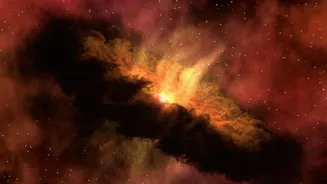
The Beta Pictoris system is a star relatively close to us in galactic terms, and it's a mere infant at around 20 to 23 million years old—a toddler compared to our own Sun, which is about 4.6 billion years old. This youth is precisely what makes it so exciting for scientists. It's surrounded by a massive, bright ring of dust and rocky debris left over from its formation. Studying this 'debris disk' and the planets within it is like having a time machine that shows us what our own solar system might have looked like during its chaotic early days. Finding Beta Pictoris d provides another key piece of the puzzle, showing how giant planets interact with the disk they are born from.
Hiding in Plain Sight
So, how did a giant planet in one of the most studied star systems remain hidden for so long? The very thing that makes Beta Pictoris famous—its bright debris disk—also made the planet incredibly difficult to spot. The disk's scattered starlight creates a powerful glare that washes out the faint light from any planets orbiting inside it, defeating traditional imaging techniques. In fact, two independent teams discovered the planet almost simultaneously. While the JWST team found it by detecting methane and carbon monoxide in its atmosphere, another team using the Very Large Telescope in Chile managed to find it by using advanced ground-based imaging and even spotted its faint signature in archival images stretching back 11 years.
A New Method for Planet Hunting
The discovery of Beta Pictoris d is more than just adding another planet to the catalogue; it's a proof of concept for a new way of finding worlds. Instead of trying to take a direct picture, which is often impossible, JWST used its powerful Near-Infrared Spectrograph (NIRSpec) to analyse the light from the system. By spreading the light into a spectrum—like a rainbow—astronomers could identify the distinct absorption lines created by molecules in the planet's atmosphere. This 'chemical fingerprint' allowed them to confirm the presence of a planet that was otherwise invisible. This technique opens the door to finding other worlds buried deep within the dusty, high-glare environments of young star systems where planets are actively forming.
The New Planet's Profile
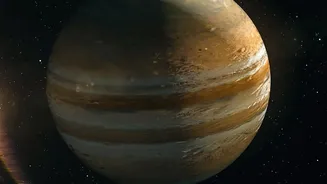
The newfound world, Beta Pictoris d, is a gas giant estimated to be at least twice the mass of Jupiter. It has the widest orbit of the three known planets in the system, taking approximately 91 years to circle its star at a distance comparable to Neptune's from our Sun. Its position is particularly interesting because it orbits just inside the inner edge of the system's vast debris disk. Scientists believe its gravitational pull may be responsible for sculpting that very edge, acting as a cosmic architect that shapes the entire system. Studying its orbit and influence will provide critical tests for theories about how giant planets migrate and settle into their final positions.