







What Did NASA's Image Show?
On August 2, 2026, NASA's Astronomy Picture of the Day (APOD) featured a spectacular photograph of what appeared to be a brilliantly coloured, flame-like cloud. The image, taken over West Virginia in the US, showcased a vibrant, horizontal splash of colour in the sky,
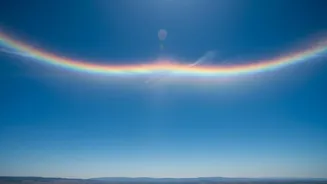
a phenomenon often called a "fire rainbow" due to its appearance. However, the scientific name for this captivating display is a circumhorizontal arc. It's part of a family of optical illusions in the atmosphere called ice halos, created by the interaction of light with ice crystals.
The Science of Ice, Not Fire or Rain
Unlike a conventional rainbow, which is formed by the refraction and reflection of sunlight through liquid water droplets, a circumhorizontal arc is created exclusively by ice. For this phenomenon to occur, specific conditions must be met. The magic happens high in the atmosphere, inside thin, wispy cirrus clouds. These clouds, existing at high altitudes, are composed of tiny, plate-shaped hexagonal ice crystals. For an arc to form, these millions of microscopic ice plates must be aligned horizontally, parallel to the ground, as they gently float through the air.
A Perfect Alignment of Sun and Crystal
The second crucial ingredient is the position of the sun. A circumhorizontal arc only forms when the sun is very high in the sky—at an elevation of at least 58 degrees above the horizon. When the sun reaches this high angle, its light enters the vertical side face of the flat, hexagonal ice crystals and is refracted, or bent, as it passes through. The light then exits through the bottom horizontal face of the crystal. This 90-degree bend acts like a prism, splitting the sunlight into its component colours and projecting a vibrant spectrum parallel to the horizon below the sun. The colours are often purer and more distinctly separated than in a typical rainbow.
Why 'Fire Rainbows' Are So Rare
The strict requirements for both the sun's high angle and the presence of correctly oriented ice crystals in cirrus clouds make circumhorizontal arcs a relatively rare sight. Their visibility is highly dependent on latitude and season. For instance, the phenomenon is impossible to see at locations north of 55°N or south of 55°S because the sun never gets high enough in the sky. In mid-latitude regions, such as much of the United States or southern Europe, they are most likely to be spotted during the summer months around midday, when the sun is at its peak elevation. Even with the right conditions, the arc might only appear as a small, colourful patch if the cirrus cloud itself is small or fragmented.
Distinguishing From Other Sky Phenomena
It's easy to confuse a circumhorizontal arc with other atmospheric optical effects, particularly cloud iridescence. Iridescent clouds also show pastel, rainbow-like colours, but their colours are typically more random and have a washed-out, 'mother-of-pearl' appearance. The key difference is the colour structure and location. A circumhorizontal arc always displays a clean spectral sequence—red on top, violet on the bottom—and always appears parallel to and far below the sun. Iridescence, caused by diffraction rather than refraction, can appear in different types of clouds and in various positions, often much closer to the sun.