




An Underwater Moon
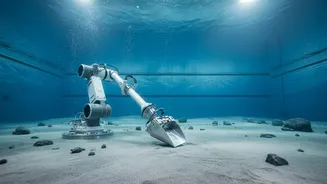
To go to the Moon, sometimes you have to go underwater first. At NASA's Neutral Buoyancy Laboratory (NBL) in Houston, a team is making this a reality. The NBL is an enormous indoor pool, measuring over 61 meters long and holding 6.2 million gallons of
water, and it's one of the most effective places on Earth to simulate the feeling of working in space. By carefully weighting down prototype spacesuits, engineers and divers can make a person feel as though they are operating in the Moon's one-sixth gravity. Recently, two NASA scientists, exploration geologists Trevor Graff and Angela Garcia, donned these special suits and descended into the simulated lunar environment. This wasn't just a swim; it was a crucial dress rehearsal for the Artemis program's future missions to the lunar surface.
Tools for a New Era
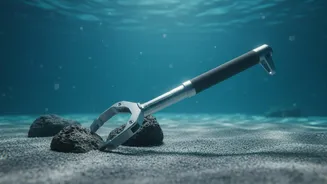
The primary goal of these underwater exercises is to test the equipment astronauts will rely on. Graff and Garcia worked with a range of prototype geology tools, including hammers, rakes, tongs, and sample collectors. The objective is to see how these tools function in a low-gravity environment where a simple swing of a hammer can send an astronaut spinning. They practiced kneeling, moving across a specially constructed floor designed to resemble the rocky, sandy lunar landscape, and collecting samples. This hands-on testing is invaluable. It helps engineers refine the designs, making the tools more efficient and ergonomic for gloved hands in bulky spacesuits. It’s about discovering the practical challenges—how to secure a tool, how to manage leverage, and how to perform delicate science—long before leaving Earth.
Practicing in the Shadows
A key focus of the Artemis missions is the Moon's South Pole, a region believed to be rich in water ice but also one of perpetual, long shadows. To prepare for this, the NBL test wasn't just about gravity; it was also about light. The team used carefully controlled, low-angle lighting to recreate the harsh visual conditions of the lunar pole, where the sun barely rises above the horizon. These deep shadows can hide craters and boulders, making navigation and scientific work incredibly difficult. By training in this environment, scientists can develop strategies and modify equipment to ensure astronauts can work safely and effectively, even when visibility is poor. This exercise was the first time two geologists were suited up together for this kind of training in the NBL, marking a significant step forward for the Artemis program.
Paving the Way for Artemis
This underwater work is a critical piece of the much larger Artemis program, NASA's ambitious plan to establish a long-term human presence on the Moon and eventually send astronauts to Mars. Missions like Artemis IV, planned for around 2028, will be the first crewed lunar landing since the Apollo era ended more than 50 years ago. Success on these missions requires more than just a powerful rocket. It demands that every tool, every procedure, and every astronaut is perfectly prepared for the lunar environment. The tests being conducted in the NBL provide essential data that will inform everything from final tool selection to the training regimen for the astronauts who will one day use them to make new discoveries on the Moon.