







A Perfectly Puzzling Planet
Planetary magnetic fields are usually a messy business. Generated by the churning of liquid metal deep inside a planet's core, they act like a protective bubble against the harsh solar wind. On Earth, our magnetic axis is tilted about 11 degrees from
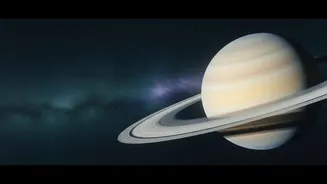
our rotational axis. This tilt is crucial; dynamo theory, the framework for how these fields are born, says a tilt is necessary to sustain the internal currents that power the field. Without it, the field should die. But Saturn breaks the rules. Before the Cassini mission’s final orbits, observations showed Saturn’s magnetic field was almost perfectly aligned with its rotation axis, with a tilt of less than one degree. This presented a major puzzle: how could Saturn sustain such a strong magnetic field when it was missing a key ingredient that theories demanded? It was a perfectly symmetrical field that, according to textbooks, simply shouldn't exist.
Cassini's Grand Finale
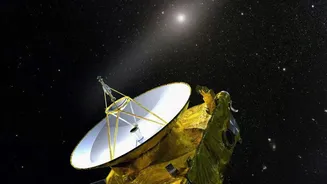
The key to solving the mystery lay with the Cassini spacecraft. After 13 years of transforming our understanding of the Saturnian system, the mission was designed for a spectacular end. In 2017, during its “Grand Finale,” Cassini performed 22 daring dives into the unexplored gap between Saturn and its innermost rings, getting closer to the planet than ever before. These final orbits provided an unprecedented opportunity to measure the magnetic field directly, close to its source. Scientists hoped that by getting 'under the hood', they could find the hidden complexities that would explain Saturn's impossible perfection. It was a high-risk, high-reward maneuver that promised to either confirm the anomaly or finally reveal the secrets hidden by the planet's cloudy exterior.
An Asymmetrical Surprise
The Grand Finale data did not disappoint. While the external field appears strikingly symmetrical, recent analysis reveals a different story unfolding within the magnetosphere. Analysis of Cassini data shows that Saturn's magnetic shield is noticeably lopsided. A key feature, the magnetospheric cusp—a funnel-like opening where solar particles can enter the atmosphere—is not centered at the 'noon' position as it is on Earth. Instead, Saturn’s rapid rotation and the sheer volume of charged plasma spewed by its moon Enceladus drag this feature far towards the 'afternoon' side. This constant downpour of water group ions from Enceladus's geysers loads up Saturn's magnetosphere, making it heavy and sluggish, allowing the planet's fast 10.7-hour spin to dominate and warp its shape.
Solving the Dynamo Dilemma
So how does this warped, lopsided interaction explain the perfectly aligned exterior? The close-up measurements from Cassini's final dives provided the answer. The data revealed complex magnetic structures and currents close to the planet that were previously invisible. These findings suggest a multi-layered dynamo system. While the deep core generates the main field, a shallower layer within Saturn's atmosphere, possibly influenced by the rings raining material onto the planet, creates secondary magnetic effects. These upper layers may effectively 'screen' the complexities of the deep dynamo, presenting a simple, symmetrical face to the outside world while hiding a much more chaotic system beneath. This allows the internal field to have the necessary complexity to survive, while the external field maintains its unusual alignment, solving the long-standing paradox.
A New Understanding of Giant Planets
The new analysis of Cassini data forces a rethink of how giant planets operate. It confirms that at this scale, a planet's own rotation and its relationship with its moons can be more influential in shaping its magnetic environment than the solar wind. This is a fundamental departure from the model at Earth, where the solar wind is the primary driver of our magnetosphere's shape. Understanding this different regime is crucial, not just for Saturn, but for studying the hundreds of gas giant exoplanets discovered around other stars. By decoding the strange behaviour of our own ringed giant, scientists now have a better toolkit for interpreting what they might find in distant solar systems and a new appreciation for the diverse ways planets can generate and sustain their magnetic shields.