







The Hunt for the Universe’s Missing Mass
For decades, physicists have been on a ghost hunt. They know that about 85% of the matter in the universe is missing. We can see its gravitational effects—it holds galaxies together—but we cannot see the matter itself. They call this mysterious substance
'dark matter.' One of the leading candidates for what dark matter is made of is a hypothetical particle called the axion. It's predicted to be incredibly light, barely interacting with the world we know. Finding it would be a Nobel Prize-winning achievement, confirming theories and solving one of the biggest puzzles in cosmology. Numerous multi-million dollar experiments around the globe have been meticulously designed with a singular goal: to catch the first definitive glimpse of an axion and prove it exists.
An Ambitious Experiment Hits a Wall
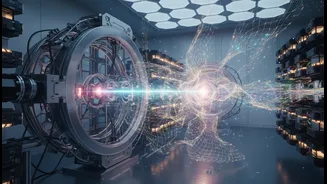
One of the most promising methods for finding axions involves creating an enormously powerful magnetic field. The theory goes that if an axion passes through this field, there is a tiny chance it will convert into a photon—a particle of light—that our sensitive instruments can then detect. A major international research collaboration recently completed a multi-year run of their experiment, scanning the precise frequency range where many models predicted the axion would be found. After painstakingly analysing the data, the team announced their result: nothing. They found no evidence of axions converting into photons. On the surface, this was a significant detection failure. The elusive particle remained elusive, and the silence from the detectors was deafening. For the researchers, a null result can be deeply frustrating after investing years of work and immense resources.
Finding a Signal in the Silence
But this is where the story turns. In modern physics, a null result is not just a failure; it's a piece of data in itself. The fact that no axions were detected in that specific range allows scientists to 'rule out' certain models. It tells theorists that their calculations might be wrong, forcing them to refine their ideas about what the axion is, or where it might be hiding. The failure becomes a critical constraint, narrowing the search for everyone else. More intriguingly, the team that ran the experiment didn't just report silence. To look for a faint axion signal, they first had to build the quietest, most stable detector on Earth. They had to account for every possible source of background noise—from distant radio signals to the quantum jitters of their own equipment. In the process of characterising this noise with unprecedented precision, they found a tiny, persistent anomaly that they could not explain.
A New Clue from an Unlikely Source
This anomaly, once considered an annoying bit of background interference to be filtered out and ignored, is now the centre of attention. It’s too weak and in the wrong place to be the axion they were looking for, but it is consistent and doesn't match any known physical process. This is the new theoretical clue. Has the experiment accidentally stumbled upon something else entirely? Perhaps a sign of a different, unexpected particle interaction, or even a subtle manifestation of a new law of physics? The detection failure for the primary target has inadvertently turned the experiment into a discovery machine for something else. The focus of the research is now shifting from 'Where is the axion?' to 'What is this strange noise?' It’s a pivot from a targeted search to open-ended exploration, driven entirely by an unexpected result.