





The Efficiency Question
When we talk about solar panel efficiency, we’re talking about the percentage of sunlight hitting a panel that gets converted into usable electrical energy. For decades, the solar panels on rooftops and in large solar farms have relied on single-junction
silicon cells. While incredibly successful, this technology is approaching its physical limits. Most commercially available high-efficiency panels today convert around 20-23% of sunlight into electricity. The theoretical maximum for a standard silicon cell, known as the Shockley-Queisser limit, is about 33.7%. This fundamental ceiling exists because a single material can only effectively capture a specific portion of the sun's light spectrum. Energy from some light particles (photons) is lost as heat, while other photons pass straight through without being absorbed. For years, scientists have been racing to overcome this barrier.
Two Layers Are Better Than One
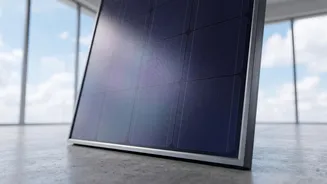
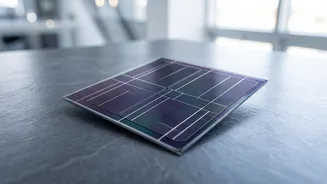
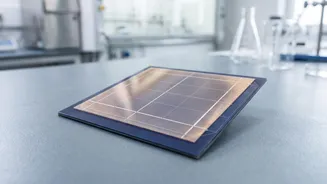
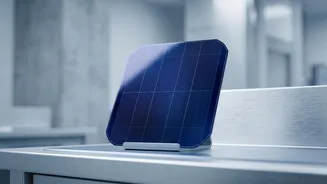
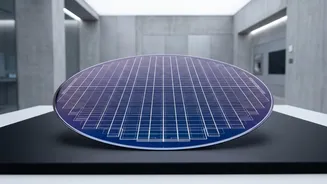
The secret to smashing through that efficiency ceiling lies in tandem solar cells. Instead of relying on a single material, a tandem cell stacks two different types of solar cells on top of each other. The most promising combination layers a thin, lightweight material called perovskite on top of a traditional silicon base. Think of it like using two different fishing nets—one with small holes for small fish and another with large holes for big fish. The top perovskite layer is excellent at capturing high-energy light, like blue and green light. The remaining lower-energy red and infrared light passes through the perovskite and is then captured by the silicon layer below. By working together, these two layers convert far more of the total solar spectrum into electricity than either could alone, dramatically boosting the potential efficiency.
Crossing the 30% Threshold
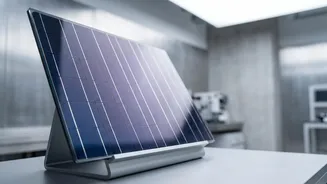
For a long time, surpassing 30% efficiency was seen as a critical milestone that would prove the viability of tandem technology. In July 2026, solar technology company LONGi announced it had not only broken that barrier but set a new world record of 35.5% efficiency for its perovskite-on-silicon tandem cell. This achievement is significant because it pushes tandem cells beyond the theoretical maximum of single-junction silicon cells. It marks a pivotal shift from a promising laboratory concept to a technology with a clear path toward commercial application. While these are still lab-produced cells, this record demonstrates that the underlying science is sound and that the potential for ultra-high-efficiency solar power is real.
From Lab Record to Indian Rooftops
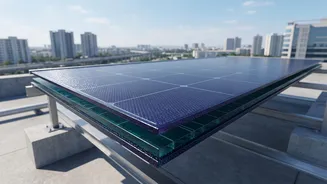
For a country like India with ambitious renewable energy targets and high population density, higher efficiency is a game-changer. The most immediate benefit is space optimization. A panel with 35% efficiency can generate significantly more power from the same rooftop area compared to a 22% efficient panel. This is crucial for urban homes and businesses where space is limited. Higher efficiency also translates to lower balance-of-system costs. To achieve a target power output, you need fewer panels. This means less money spent on mounting structures, wiring, and labour, which can reduce the overall cost of a solar installation and shorten the payback period. For large-scale solar farms, it means producing more energy on less land, addressing a key constraint for utility-scale projects.
What Happens Next?
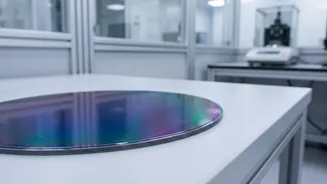
Despite the excitement, you won't find 35% efficient panels at your local installer just yet. There are still major hurdles to overcome before tandem cells become a mainstream commercial product. The biggest challenge is durability. Perovskite materials can degrade when exposed to moisture and heat over long periods, so researchers are working to develop protective encapsulation and more stable chemical formulas. The second challenge is manufacturing at scale. The record-setting cells are made in controlled laboratory environments. Scaling up production to create large, uniform, and affordable panels for the mass market is a complex engineering task. It will likely take several more years of development before perovskite-tandem panels are widely available and cost-competitive.