






In the vast cosmic theater, some celestial objects are neither stars nor planets but something in between. These are brown dwarfs, often called 'failed stars'. NASA's SPHEREx mission is helping us understand these enigmatic objects like never before.
Meet SPHEREx: NASA's Cosmic Mapper
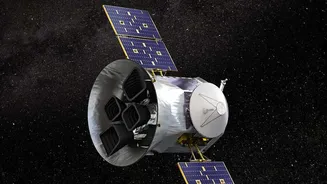
Launched in March 2025, NASA’s SPHEREx (Spectro-Photometer for the History of the Universe, Epoch of Reionization, and Ices Explorer) is an ambitious mission designed to create a 3D map of the entire sky. Unlike telescopes that focus on small patches of the cosmos, SPHEREx conducts an all-sky survey every six months. It observes in near-infrared light, which is invisible to the human eye but perfect for peering through cosmic dust and studying cooler objects. Its primary goals are incredibly grand: to study the rapid expansion of the universe just after the big bang, investigate the origins of galaxies, and search for water and organic molecules—the building blocks of life—in stellar nurseries. While doing all this, it also happens to be a perfect tool for hunting and analyzing one of the most mysterious objects in the universe: the brown dwarf.
The Cosmic Middle Ground: What Is a Brown Dwarf?
A brown dwarf is an object that occupies the fascinating gap between the largest gas giant planets, like Jupiter, and the smallest stars. They form just like stars do, from the gravitational collapse of a dense cloud of gas and dust. However, they never quite manage to accumulate enough material to make the final leap to stardom. Think of them as stellar underachievers. The dividing line is mass: a brown dwarf is more massive than a planet but falls short of the minimum mass required to be a star. This leaves them in a unique position, too small to be a star, but often too large and formed differently to be considered a planet.
The Stellar Litmus Test: Igniting a Star
What truly defines a star is its ability to create its own light and heat through sustained nuclear fusion in its core. Specifically, a star must be able to fuse hydrogen, the most abundant element in the universe, into helium. This process, known as the proton-proton chain, releases an immense amount of energy, which pushes outward and counteracts the crushing inward pull of the star's own gravity. To kickstart this fusion engine, the core of a protostar needs to reach an incredible temperature of at least 10 million Kelvin. The only way to achieve that is with immense pressure, which is generated by having an enormous amount of mass. The magic number, astronomers have calculated, is about 80 times the mass of Jupiter, or roughly 8% of the mass of our Sun.
Why Brown Dwarfs Fail the Test
This is where brown dwarfs fall short. They simply do not have enough mass. Their mass generally ranges from about 13 to 80 times that of Jupiter. While they are born hot from the energy of their gravitational collapse, their cores never reach the critical pressure and temperature needed for sustained hydrogen fusion. Gravity squeezes, but it's not a strong enough squeeze. Without the constant energy production from hydrogen fusion, they can't achieve the long term stable equilibrium that keeps a star like our Sun shining for billions of years. They are 'failed' stars because they never successfully ignite their primary fuel source.
A Brief Glimmer of Fusion
Interestingly, the story doesn't end there. While brown dwarfs cannot fuse normal hydrogen, the most massive among them (those above 13 times Jupiter's mass) can briefly fuse a different, heavier isotope of hydrogen called deuterium. Deuterium fusion requires lower temperatures and pressures than hydrogen fusion, so brown dwarfs can sustain it for a short period—typically a few million years. This process generates some heat and makes the brown dwarf glow faintly, mostly in infrared light. However, the supply of primordial deuterium is very limited, and once it's used up, the fusion stops, and the brown dwarf begins a long, slow process of cooling down for the rest of its existence.
How SPHEREx Is Changing the Game
Because brown dwarfs are cool and dim, they are incredibly difficult to detect in visible light. They emit most of their faint energy as infrared radiation, which is exactly what SPHEREx is designed to see. By surveying the whole sky in 102 different infrared 'colors', SPHEREx can spot these dim objects and analyze the chemical composition of their atmospheres. Recent findings from the mission, published in late 2026, have analyzed dozens of brown dwarfs, revealing atmospheres rich with water, methane, and carbon monoxide. This data is helping scientists test and refine their models of how both planets and stars form, providing crucial realworld information on these mysterious objects that bridge the gap between two of any cosmos's main categories.