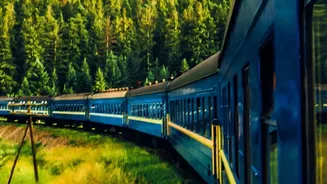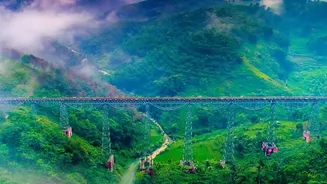







A Route of Stunning Beauty and Steep Challenges
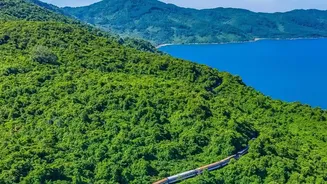
The 55-kilometre stretch of railway between Sakleshpur and Subrahmanya Road is an engineering marvel that cuts through the dense Western Ghats. It is famous among travellers for its breathtaking views, especially during the monsoon season. However, for railway operations,
it's a formidable challenge. The line features a steep gradient of 1-in-50, meaning the track rises one metre for every 50 metres travelled. It navigates through 57 tunnels, over 226 bridges, and around 108 sharp curves. This terrain, which is also prone to landslides, requires trains to operate with extreme caution and specialized support, making it one of the most technically demanding sections in the entire Indian Railways network.
What Are These Stability Tests?
The recent tests conducted by the South Western Railway's Mysuru Division are officially known as oscillation and field trials. These are designed to assess how a train behaves on a specific track under real-world conditions. Personnel from the Research Designs and Standards Organisation (RDSO), the research and development arm of Indian Railways, were on board to monitor various parameters. The trials measure factors like stability, acceleration, and braking performance. A crucial component being tested is a new Automatic Emergency Braking (AEB) system. This system is designed to automatically apply the brakes if the train exceeds the mandated speed limit on the ghat, which is capped at a cautious 30 kmph, providing a critical layer of safety on the steep inclines.
Focus on the Vande Bharat Express
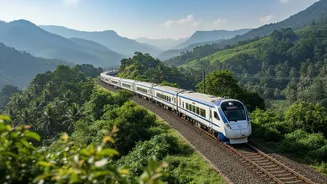
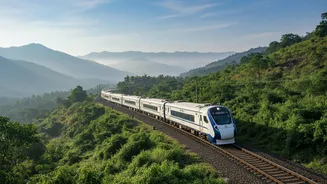
These specific trials involved a specially manufactured 20-car Vande Bharat Express rake, built by the Integral Coach Factory (ICF) in Chennai. The goal is to evaluate the feasibility of running this semi-high-speed train on the proposed Bengaluru-Mangaluru route. While the Vande Bharat is known for its speed on flat terrain, the unique challenges of the ghat section require rigorous validation. Concerns had been raised previously about operating a conventional Vande Bharat trainset on this stretch without additional braking safeguards. The current tests with the AEB-equipped rake are a direct response to those safety requirements and a vital step before any commercial service can be authorised.
What This Means for Future Travel
The successful completion of these trials could have significant benefits for passengers. Primarily, it paves the way for the potential launch of a Vande Bharat Express service connecting the tech hub of Bengaluru with the coastal city of Mangaluru. This would offer faster and more comfortable connectivity between the state capital and the important coastal region. The route already features Vistadome coaches on other trains, which are immensely popular for their panoramic windows offering stunning views of the ghats. The introduction of a modern train service like the Vande Bharat, proven to be safe for this difficult terrain, would further enhance the appeal of this iconic journey, blending high-end engineering with natural beauty. Before the service can be launched, the RDSO will submit its findings to the Railway Board and the Commissioner of Railway Safety for final approval.