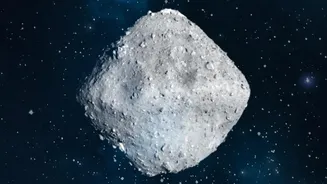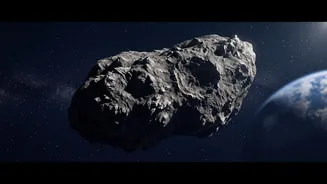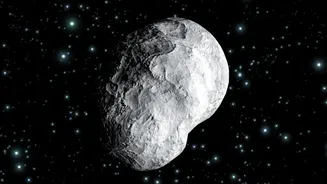






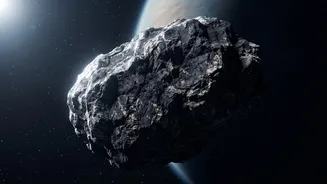
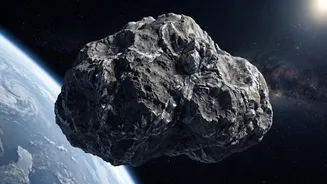

When we picture an asteroid hurtling through space, we often imagine a simple, round rock. But the reality is far lumpier and more complex. New research from Sandia National Laboratories shows why that complexity is critical for planetary defense.
The Myth of the Perfect Sphere
For
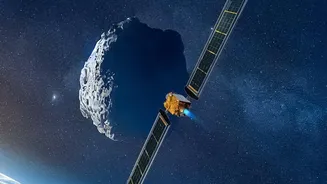
years, scientists planning for the unlikely but catastrophic possibility of an asteroid impact have relied on simplified models. To make the incredibly complex calculations manageable, simulations often treated asteroids as perfect spheres. The problem, as Sandia physicist Nathan Moore notes, is that 'spherical asteroids don't exist'. In the real solar system, these objects are irregular, lumpy, and full of ridges, craters, and uneven surfaces. This isn't just a minor detail. Assuming a smooth, round shape can lead to significant errors when predicting how an asteroid would react to a deflection attempt, whether from a kinetic impactor like NASA's DART mission or a standoff nuclear detonation. The shape dramatically affects how energy is absorbed and how the resulting force pushes the asteroid, making older models a potentially unreliable guide for a real-world planetary defense scenario.
A Breakthrough in Simulation
The Sandia team, led by Moore, developed a new modeling technique that, for the first time, combines realistic, high-resolution 3D asteroid shapes with high-fidelity physics calculations. Previously, researchers had to choose between one or the other; combining both was too computationally demanding for existing systems. The breakthrough came from an innovative approach that merged two of Sandia's powerful simulation codes: ALEGRA, typically used for high-energy events, and SPARTA, used for weaker, slowly evolving forces. This hybrid model runs over 1,600 times faster than previous methods, finally making it possible to simulate complex scenarios accurately. Researchers can now take detailed 3D imagery from spacecraft flybys and run simulations that show exactly how a burst of X-rays from a nuclear device would vaporize parts of the irregular surface and alter the asteroid's path.
Why Aim Is Everything
The results from the new simulations are striking and underscore the importance of this new level of detail. The research, published in the journal Icarus, shows that where you target an irregular asteroid matters immensely. In one simulation, hitting one side of an asteroid produced a change in velocity of 3.9 millimeters per second. Hitting a different side of the very same asteroid resulted in a change of just 0.8 millimeters per second—a nearly fivefold difference in effectiveness. The effect on the asteroid's rotation was even more pronounced, varying by a factor of 17 depending on the impact point. 'We expected aim to matter,' Moore stated, 'What surprised us was how much'. These findings prove that a 'one-size-fits-all' approach is inadequate. An effective deflection strategy requires precise knowledge of the asteroid's shape to identify the optimal point of impact.
From Theory to Practical Defense
This research moves planetary defense from the realm of broad theory to specific, data-driven strategy. While methods like kinetic impactors have been successfully tested by missions such as DART, a standoff nuclear blast remains a key option for deflecting a large, dangerous object discovered with little warning time. Sandia's work provides a crucial tool for planning such a mission. With these advanced models, defense coordinators could rapidly simulate various scenarios for a newly identified threat, provided its shape is known. It allows them to determine not just if a deflection is possible, but how to execute it for maximum effect while minimizing the risk of the asteroid fracturing into multiple hazardous pieces. This capability is a cornerstone of modern planetary defense, which relies on a triad of detection, tracking, and mitigation strategies.